---
title: "How Long Should a YouTube Short Be? Maximize Views 2026"
canonical: "https://blitzreels.com/blog/how-long-should-a-youtube-short-be"
---
# How Long Should a YouTube Short Be? Maximize Views 2026
URL: https://blitzreels.com/blog/how-long-should-a-youtube-short-be
Markdown URL: https://blitzreels.com/blog/how-long-should-a-youtube-short-be.md
Published: 2026-06-18
Author: BlitzReels
How long should a YouTube Short be for max views? Discover 2026's official limits & optimal lengths for discoverability, retention, and conversions.
Tags: how long should a youtube short be, youtube shorts length, youtube shorts best practices, video marketing, short form video

YouTube Shorts can now be **up to 3 minutes** when uploaded as square or vertical videos, but the strongest performance patterns still sit in two ranges: **20 to 45 seconds** for high retention and **50 to 60 seconds** for value-dense Shorts that can travel further. The best answer to how long a YouTube Short should be isn't one magic number. It's the length that delivers a complete idea while keeping viewers watching most or all of it.
A lot of Shorts advice still pushes a simplistic rule: keep it as short as possible. That advice sounds tidy, but it breaks down fast in practice. A rushed Short that cuts off the payoff won't hold attention, won't earn replays, and usually won't move a viewer toward a click, follow, or sale.
The better question is this: what length gives this specific idea the highest completion without starving it of context? For a reaction, hook, or one-point tip, that may be brief. For a transformation clip, product demo, mini-story, or repurposed podcast moment, a longer runtime can be the smarter choice. Runtime is a strategy decision, not a default.
## Table of Contents
- [The Surprising Answer to Your YouTube Shorts Length Question](#the-surprising-answer-to-your-youtube-shorts-length-question)
- [Choose the full idea, then trim hard](#choose-the-full-idea-then-trim-hard)
- [What usually doesn't work](#what-usually-doesnt-work)
- [Understanding the Official YouTube Shorts Duration Rules](#understanding-the-official-youtube-shorts-duration-rules)
- [What YouTube allows now](#what-youtube-allows-now)
- [The audio rights constraint creators miss](#the-audio-rights-constraint-creators-miss)
- [How to Choose Your Shorts Length by Content Goal](#how-to-choose-your-shorts-length-by-content-goal)
- [Choose length by outcome, not habit](#choose-length-by-outcome-not-habit)
- [A practical decision framework](#a-practical-decision-framework)
- [The 50-60 Second Sweet Spot for Viral Potential](#the-50-60-second-sweet-spot-for-viral-potential)
- [Why longer Shorts can outperform](#why-longer-shorts-can-outperform)
- [When this length fails](#when-this-length-fails)
- [How to Edit Your Video for Maximum Impact](#how-to-edit-your-video-for-maximum-impact)
- [Editing decisions matter more than runtime alone](#editing-decisions-matter-more-than-runtime-alone)
- [A tighter workflow for better Shorts](#a-tighter-workflow-for-better-shorts)
- [Frequently Asked Questions About YouTube Shorts Length](#frequently-asked-questions-about-youtube-shorts-length)
- [Does looping a Short to make it longer work](#does-looping-a-short-to-make-it-longer-work)
- [How does length affect monetization](#how-does-length-affect-monetization)
- [One 60-second Short or three 20-second Shorts](#one-60-second-short-or-three-20-second-shorts)
## The Surprising Answer to Your YouTube Shorts Length Question
The most useful answer to **how long should a YouTube Short be** is that there isn't a universal best length. The platform has a technical limit, but the best-performing runtime depends on what the video needs to do. A strong hook, sharp pacing, readable captions, and a clean ending often matter more than picking a fixed second count.
That matters because creators often choose length backward. They start with a number, then force the idea to fit it. The stronger approach is the reverse. Start with the message, cut dead air, and stop when the point lands.
### Choose the full idea, then trim hard
A Short should feel complete, not merely short. If a product comparison needs setup, proof, and a quick conclusion, pushing it into an ultra-short format can weaken it. If a clip is just one punchline or one visual reveal, stretching it hurts more than it helps.
> **Practical rule:** The right length is the shortest version that still feels finished.
That usually leads to three workable outcomes:
- **Fast payoff clips** work when the viewer can understand the setup instantly and the reward lands quickly.
- **Mid-length Shorts** work when the creator needs enough room for one lesson, one example, or one visual sequence.
- **Longer Shorts** work when the audience benefits from a full mini-story, a richer explanation, or a stronger emotional arc.
Creators building across platforms often run into the same issue with TikTok, Reels, LinkedIn, and Shorts: the edit that works on one platform may need a tighter hook, larger captions, or a cleaner title card elsewhere. A broader [short-form video workflow guide](https://www.blitzreels.com/blog/short-form-video) is useful because runtime only works when the packaging does too.
### What usually doesn't work
Two patterns fail repeatedly. The first is bloated pacing. The second is over-compression, where the clip moves so fast that the viewer gets the information but not the reason to care.
A good Short respects attention without sounding rushed. That's why the conversation shouldn't be about chasing one perfect number. It should be about matching runtime to retention, clarity, and the job the video is supposed to do.
## Understanding the Official YouTube Shorts Duration Rules
YouTube's official rules are broader than many creators think, and the change matters because the old "under a minute or it isn't a Short" advice is outdated.
### What YouTube allows now
According to YouTube, **square or vertical videos uploaded on or after October 15, 2024 can be up to 3 minutes and still be categorized as Shorts**. YouTube also notes that some music rights can limit usable audio to **90 seconds, 60 seconds, or 30 seconds**, which means the practical limit can be lower than the upload limit depending on the track used ([YouTube Shorts help documentation](https://support.google.com/youtube/answer/15424877?hl=en)).
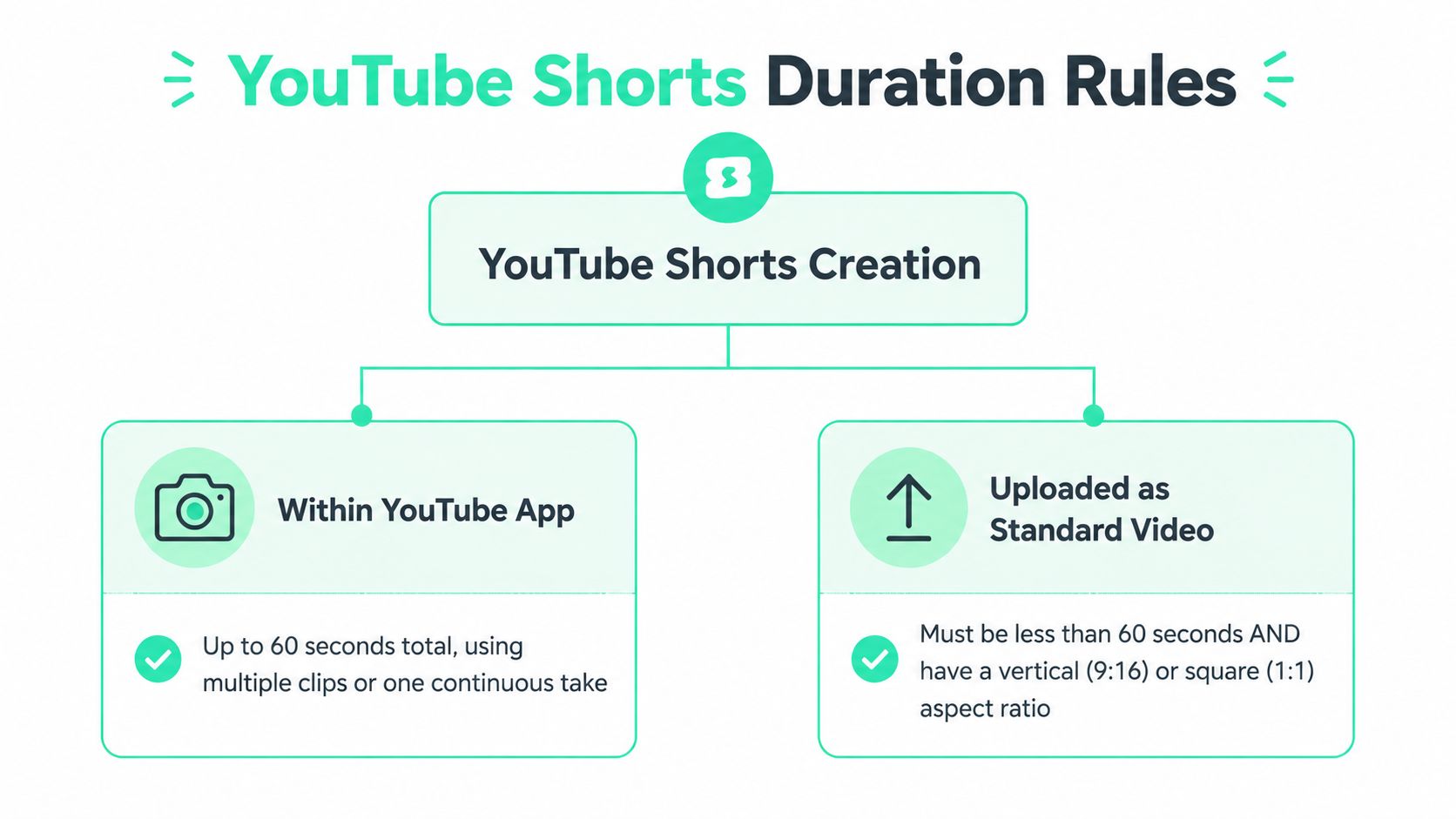
That changes planning in two ways. First, creators have more room for explainers, demos, and repurposed clips. Second, the file can qualify as a Short even when it goes beyond the older one-minute ceiling, as long as the upload format fits YouTube's rules.
For creators who want the platform definitions in one place, this [YouTube Shorts glossary entry](https://www.blitzreels.com/glossary/youtube-shorts) is helpful because it clarifies the terminology around Shorts creation and publishing.
### The audio rights constraint creators miss
The biggest trap isn't the runtime ceiling. It's licensed audio. A creator may cut a polished vertical Short that runs longer, then discover that the chosen track restricts what can be published.
> Music choices can quietly decide your maximum usable length before editing quality even enters the equation.
That means length decisions should happen after checking the audio plan, not before. If the Short relies on trending music, rights can shape the edit. If the message matters more than the song, original audio or voiceover gives more flexibility.
Creators also increasingly pair editing workflows with automation and generation tools. For anyone exploring that side of the process, Seedance has a solid piece on [mastering AI for video shorts](https://www.seedance.tv/blog/ai-video-generator-youtube-shorts-guide-2026), especially for planning cuts and packaging before export.
## How to Choose Your Shorts Length by Content Goal
Length should follow goal. A Short built for reach doesn't behave exactly like a Short built to qualify leads, explain a feature, or move someone to a profile click.
### Choose length by outcome, not habit
Miraflow's 2026 analysis notes that a good **average view duration** on Shorts is often **60 to 100% of the video length**, especially for videos under a minute. The same analysis says many successful Shorts cluster around **15 to 30 seconds**, while strong performers often sit in the **20 to 45 second** band, which highlights the trade-off between message depth and completion rate ([Miraflow analysis on Shorts length](https://miraflow.ai/blog/how-long-should-youtube-shorts-be-2026)).
That gives creators a more practical lens than "shorter is always better." If a clip keeps a high share of its runtime watched, it may deserve to stay longer. If adding context causes completion to fall, the stronger move is to tighten it.
Here is a usable planning table.
| Goal | Recommended Length | Rationale | Key Metric |
|---|---|---|---|
| Maximum discoverability | 20 to 45 seconds | Enough room for a hook, one core idea, and a satisfying payoff without dragging | Completion relative to length |
| High audience retention | 15 to 30 seconds | Easier to maintain strong watch percentage on one clean point | Watch-through and rewatch behavior |
| Conversions and qualified clicks | As short as clarity allows, often mid-length | The viewer needs enough context to trust the CTA | Whether the message stays clear through the call to action |
A creator making educational clips, founder videos, or repurposed interviews should think less about "What is the best length?" and more about "What is the shortest complete version of this clip?" Teams producing clips at scale can use a dedicated [YouTube Shorts workflow](https://www.blitzreels.com/use-cases/youtube-shorts) to test different edits from the same source footage.
### A practical decision framework
A simple decision rule works well:
- **If the hook is strong but the payoff is thin**, shorten the clip.
- **If viewers need proof or context to believe the point**, give the idea more room.
- **If the call to action comes too early**, the viewer hasn't earned enough reason to care.
- **If the ending feels abrupt**, the edit is probably too aggressive.
> A 30-second Short with strong completion usually beats a 60-second Short that loses attention halfway through.
Virality and conversion also pull in different directions. Viral clips often win because they feel complete and worth sharing. Conversion clips often need clearer framing, stronger captions, and more deliberate pacing so the viewer understands both the problem and the next step.
That is why one-size-fits-all advice fails. The optimal runtime depends on whether the creator wants a fast pattern interrupt, a satisfying story, or a concise pitch.
## The 50-60 Second Sweet Spot for Viral Potential
Short-form creators often assume that shaving seconds always improves performance. The stronger evidence points to a more nuanced pattern. Longer Shorts can do very well when they give the viewer a reason to stay.
Early in the edit process, it helps to study examples that sustain interest all the way through. This breakdown is a useful reference point:
### Why longer Shorts can outperform
A widely cited independent analysis of **5,400 YouTube Shorts** found that Shorts with an **average view duration of 50 to 60 seconds** performed especially well, and the study commentary noted those videos averaged about **4.1 million views** across the sample. A separate report found that **50 to 60 second** Shorts achieved a **76% watch-through rate**, which supports the idea that the best length is often the longest length the viewer will still watch through ([analysis of 5,400 Shorts and related performance summary](https://www.youtube.com/watch?v=ryZt5pc2O5s)).
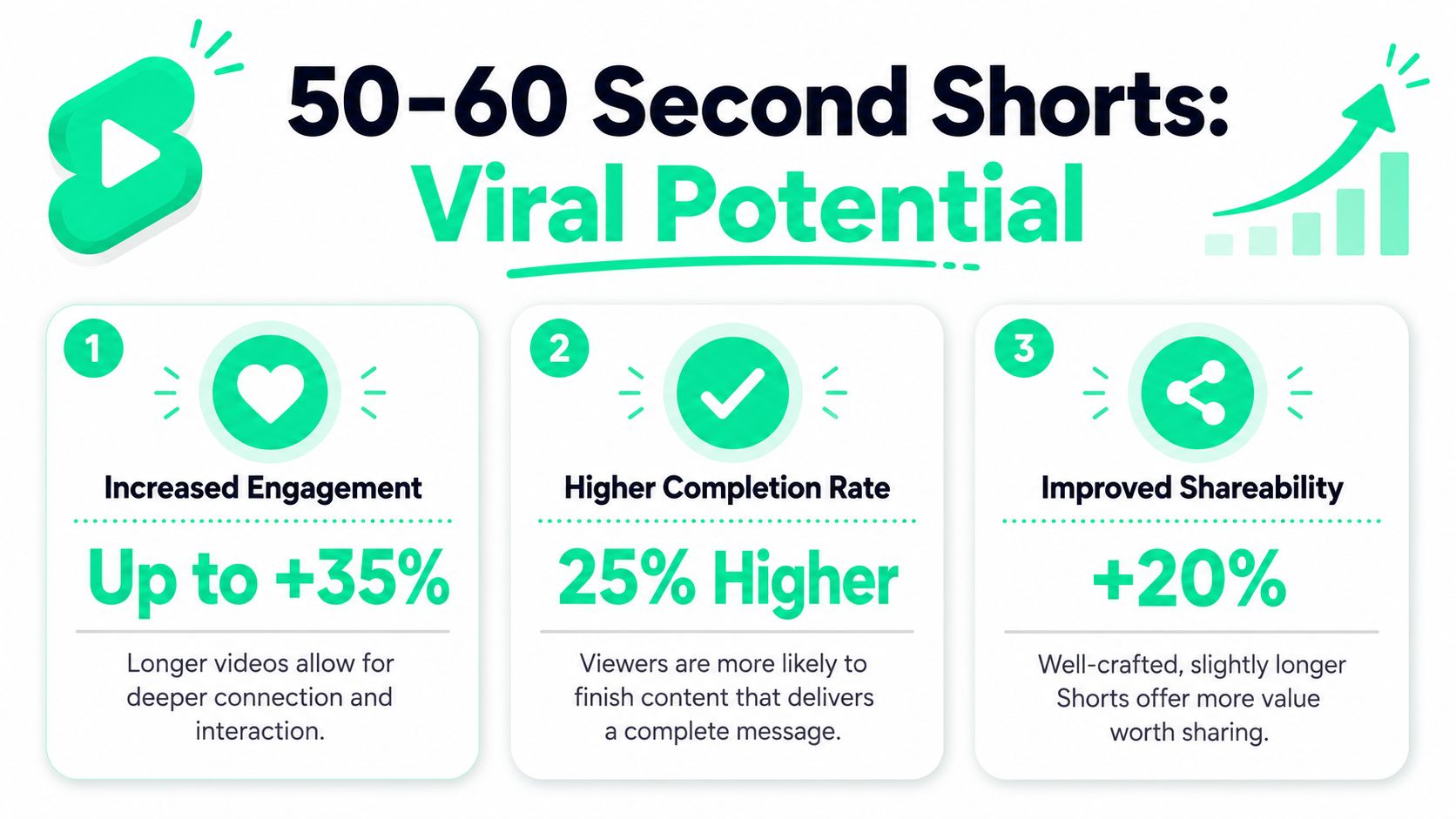
The reason is straightforward. That range gives a creator room to do more than tease. It can support a miniature narrative, a useful tutorial, a stronger before-and-after, or a layered opinion with evidence. The Short feels more substantial, and that often leads to more satisfying viewing.
For marketers thinking about packaging, thumbnails, and first-click behavior beyond Shorts, this [guide to good CTR for marketers](https://302.sh/blog/what-is-a-good-ctr) adds useful context on how hook quality and expectation-setting affect performance.
### When this length fails
This range isn't a license to ramble. It fails when the opening takes too long, when title cards stall momentum, or when captions become dense enough to feel like homework.
> Longer Shorts win only when every segment earns its place.
Creators chasing reach should treat **50 to 60 seconds** as a high-upside format, not a default setting. Use it when the idea gets better with buildup, proof, or emotional payoff. Skip it when the concept peaks in the first few beats.
For more examples of shareable structure, pacing, and opening patterns, this guide on [how to make videos go viral](https://www.blitzreels.com/blog/how-to-make-videos-go-viral) is a practical companion.
## How to Edit Your Video for Maximum Impact
The most liberating truth about Shorts length is that runtime alone doesn't explain much. Editing quality does more of the heavy lifting.
### Editing decisions matter more than runtime alone
Channel Makers reported that **video length has near-zero explanatory power for view count** in their Shorts dataset. The reported correlation between duration and views was about **r = 0.028**, meaning duration explained only about **2%** of the variation in views. The same analysis also observed a view spike around **9 to 16 seconds**, which suggests hook timing and editing density may matter more than total runtime alone ([Channel Makers Shorts analysis](https://www.youtube.com/watch?v=lGdEfQ6RWOo)).
That should change how creators edit. The target isn't just "make it shorter." The target is "remove every moment that doesn't increase curiosity, clarity, or payoff."
Three editing choices usually have the biggest effect:
- **Open with motion and context:** The first beat should tell the viewer what they're about to get. A visual change, title card, or spoken claim can do that fast.
- **Cut on meaning, not just silence:** Remove pauses, but also trim repeated phrasing, weak setup, and anything the captions already explain.
- **Use captions as pacing tools:** Good captions don't just transcribe. They emphasize key phrases, control reading rhythm, and keep sound-off viewers engaged.
### A tighter workflow for better Shorts
Fast editing matters when creators test multiple lengths from the same clip. One practical setup is to cut a dense version first, then make one shorter version and one slightly longer version with more context. Compare which one keeps the message intact while feeling easiest to watch.
Tools can speed that process. For example, [BlitzReels](https://blitzreels.com) can clip long footage into Shorts, auto-caption, reframe for vertical output, and add title cards or templates without forcing a full timeline edit. That kind of workflow is useful when a creator is turning webinars, podcasts, demos, or talking-head videos into several testable Shorts.
Writers who need stronger openings before the edit may also find this [AI YouTube Shorts script generator](https://beyondcomments.io/blog/you-tube-shorts-script-generator) useful for building cleaner hooks and tighter narration.
A polished Short usually comes from small choices repeated well: stronger clipping, better reframing, cleaner subtitle styling, and fewer wasted beats. This collection of [quick pro techniques for polished short-form videos](https://www.blitzreels.com/blog/10-quick-pro-techniques-for-polished-short-form-videos) is worth using as an editing checklist.
## Frequently Asked Questions About YouTube Shorts Length
### Does looping a Short to make it longer work
It can, if the loop feels intentional. A smooth ending that reconnects to the opening can increase rewatch value. Padding a weak clip with repeated footage usually doesn't help because the viewer feels the stall. Creative looping works when it improves the experience, not when it tries to disguise thin content.
### How does length affect monetization
Longer Shorts can create more room for story, explanation, and viewer satisfaction, which can support stronger watch behavior. But monetization decisions still come back to whether the video holds attention and delivers value. A bloated clip won't outperform a tighter one just because it runs longer.
### One 60-second Short or three 20-second Shorts
That depends on whether the idea is one complete unit or three separate payoffs. If each segment can stand on its own with its own hook and conclusion, splitting usually makes sense. If the proof, transformation, or narrative only works as a whole, keeping it together is smarter.
> If a viewer needs all parts to care, keep it as one Short. If each part can satisfy independently, split it.
The cleanest answer to **how long should a YouTube Short be** is still this: make it as short as possible, but never shorter than the idea can survive.
---
BlitzReels helps creators turn raw footage, webinars, podcasts, demos, and screen recordings into platform-ready short videos with clipping, captions, reframing, resizing, title cards, and templates built for YouTube Shorts, TikTok, Reels, and more. For teams that want to test different hooks and lengths quickly without spending hours in a traditional editor, it's a practical way to move from recording to publish-ready shorts faster.