---
title: "How to Organically Grow Instagram Followers with Short-Form"
canonical: "https://blitzreels.com/blog/how-to-organically-grow-instagram-followers"
---
# How to Organically Grow Instagram Followers with Short-Form
URL: https://blitzreels.com/blog/how-to-organically-grow-instagram-followers
Markdown URL: https://blitzreels.com/blog/how-to-organically-grow-instagram-followers.md
Published: 2026-08-09
Author: BlitzReels
Learn how to organically grow Instagram followers using short-form content. Discover proven strategies to boost engagement and reach in 2026.
Tags: instagram growth, organic followers, reels strategy, short-form video, social media marketing

The average Instagram post reached just **3.5% of a brand's followers in 2025**, down from roughly **10% to 15% in 2020**. That single shift explains why **how to Organically Grow Instagram Followers with short-form video** now feels like a systems problem, not a posting problem, because most followers won't see most posts unless the content is built to break past the existing audience threshold ([organic reach benchmark](https://www.outfame.com/blog/instagram-organic-reach-statistics)).
Organic growth still happens, but it happens through **repeatable Reels, strong hooks, niche clarity, and profile conversion**. Healthy mature accounts are often looking at **3% to 5% monthly growth**, while larger accounts tend to be stronger at **1.5% to 3%** and smaller accounts can move faster because each new follower shifts the base more sharply ([monthly growth benchmark](https://heistbrain.com/benchmarks/instagram-follower-growth.html)).
## Table of Contents
- [Why Organic Instagram Growth Feels Harder in 2026](#why-organic-instagram-growth-feels-harder-in-2026)
- [What that looks like in practice](#what-that-looks-like-in-practice)
- [Start with niche and profile conversion](#start-with-niche-and-profile-conversion)
- [Building 3 to 5 Content Pillars That Compound](#building-3-to-5-content-pillars-that-compound)
- [Build pillars from audience questions, not brand vanity](#build-pillars-from-audience-questions-not-brand-vanity)
- [Map each pillar to a Reel pattern](#map-each-pillar-to-a-reel-pattern)
- [Hook and Retain Reels That Trigger the Algorithm](#hook-and-retain-reels-that-trigger-the-algorithm)
- [Rewrite the opening for tension](#rewrite-the-opening-for-tension)
- [Keep the viewer moving](#keep-the-viewer-moving)
- [Captions, Hashtags, and On-Screen Text That Convert Views to Follows](#captions-hashtags-and-on-screen-text-that-convert-views-to-follows)
- [Use a three-part caption structure](#use-a-three-part-caption-structure)
- [Layer hashtags by role, not by volume](#layer-hashtags-by-role-not-by-volume)
- [Make on-screen text do real work](#make-on-screen-text-do-real-work)
- [Posting Cadence and Cross-Posting Without Cannibalizing Reach](#posting-cadence-and-cross-posting-without-cannibalizing-reach)
- [Repurpose one recording into multiple cuts](#repurpose-one-recording-into-multiple-cuts)
- [Cross-post without making every platform look identical](#cross-post-without-making-every-platform-look-identical)
- [Engagement Workflows That Compound Discovery](#engagement-workflows-that-compound-discovery)
- [Use a timed daily block](#use-a-timed-daily-block)
- [Read the four metrics that matter](#read-the-four-metrics-that-matter)
- [Run a clean A/B test](#run-a-clean-ab-test)
- [A 30, 60, and 90 Day Posting Plan](#a-30-60-and-90-day-posting-plan)
- [Days 1 to 30](#days-1-to-30)
- [Days 31 to 60](#days-31-to-60)
- [Days 61 to 90](#days-61-to-90)
## Why Organic Instagram Growth Feels Harder in 2026
The platform is more compressed than it used to be, and that changes everything about what counts as progress. Independent benchmark data says the **average Instagram post reached just 3.5% of a brand's followers in 2025**, down from roughly **10% to 15% in 2020**, while Socialinsider's 2025 reporting also shows engagement down about **24% year over year** and follower growth slowing across account sizes ([reach decline benchmark](https://www.outfame.com/blog/instagram-growth-statistics)).
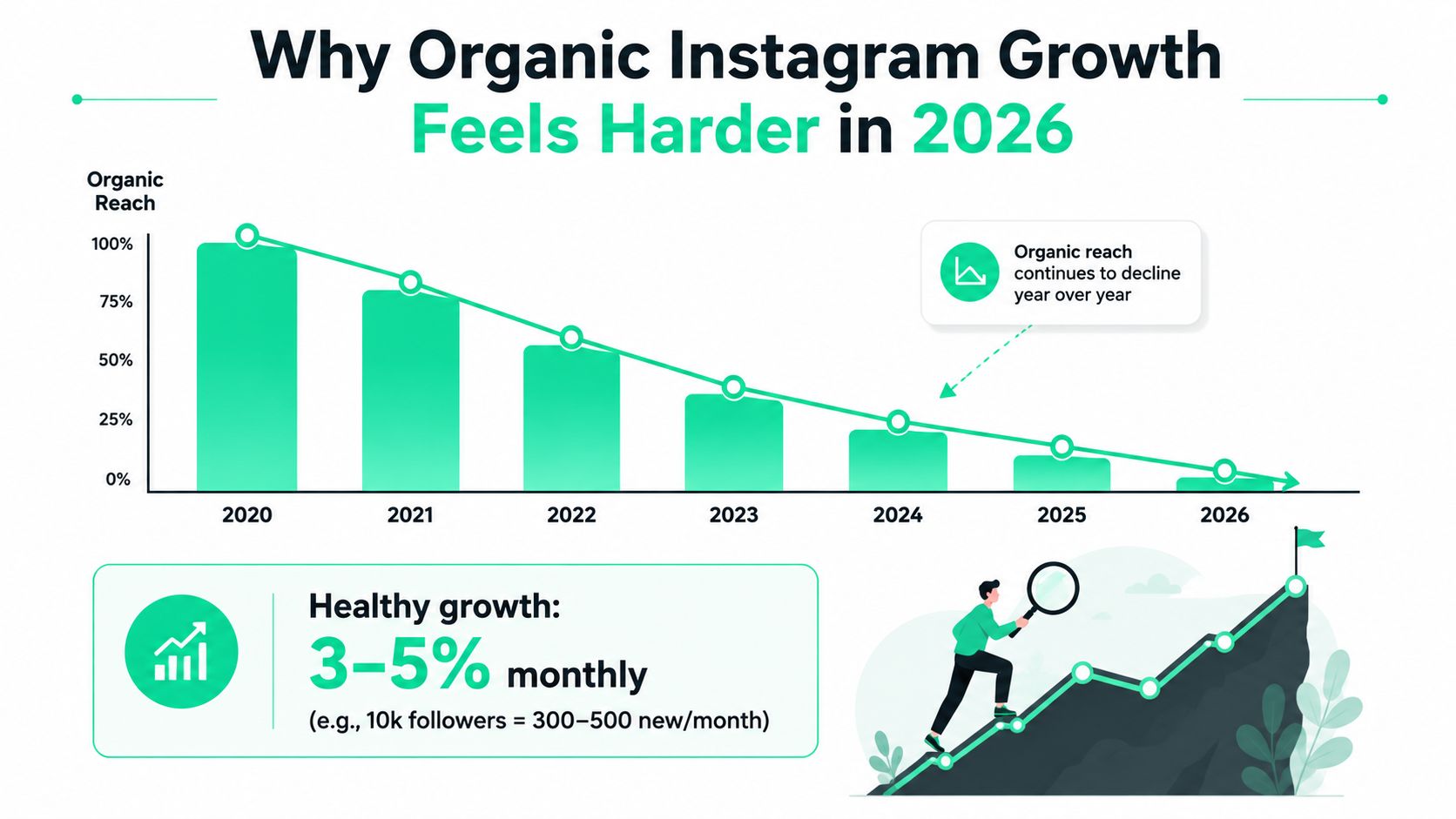
A healthy mature account should think in **low single-digit monthly growth**, not in viral spikes. Industry benchmark reporting places sustainable growth around **3% to 5% per month** for many non-viral accounts, with larger accounts often considered strong at **1.5% to 3%** and smaller accounts able to post higher percentages because the base is smaller ([follower growth benchmark](https://heistbrain.com/benchmarks/instagram-follower-growth.html)).
### What that looks like in practice
If an account starts the month with **10,000 followers** and grows at **5%**, that's about **500 new followers in a month**, or roughly **17 per day** ([same benchmark](https://heistbrain.com/benchmarks/instagram-follower-growth.html)). That's not a fireworks moment, it's a solid compounding month, and it's enough to build authority if the content keeps converting profile visits into follows.
> **Practical rule:** treat every Reel like a small distribution test, not a standalone event. The goal is to get enough qualified non-followers to stop, watch, and visit the profile.
That mindset matters because Instagram has moved from a relatively open organic-discovery environment in 2020 to a much tighter one by 2025. Smaller accounts can still grow faster in percentage terms, while large profiles often slow as the audience gets harder to expand, so the key lever is not volume for its own sake, it's **volume with a clear format and repeatable conversion path** ([growth-size relationship](https://www.outfame.com/blog/instagram-growth-statistics)).
### Start with niche and profile conversion
The first fix isn't another Reel idea, it's a sharper audience target. A creator who says “fitness” is competing with a massive field, while a creator who says “busy professionals who need 15-minute strength workouts” gives the algorithm and the viewer something specific to recognize.
A useful workflow is to study **5 to 10 lookalike accounts** and mine their comments for exact phrasing. The point isn't to copy their content, it's to map the recurring questions, objections, and word choices your future followers already use. Those comments become raw material for Reel openings, captions, and titles.
A profile should pass a quick conversion check:
- **Bio clarity:** the first line should explain who the account helps and what it posts.
- **Name-field keyword:** the searchable name field should reflect the niche, not a vague brand label.
- **Link-in-bio destination:** visitors should land on one clear next step, not a cluttered menu.
- **Grid-first-impression test:** the profile grid should look like a coherent promise, not a random archive.
For creators comparing short-form formats across platforms, this internal comparison is useful as a companion read: [Reels, TikTok, or Shorts in 2026](https://www.blitzreels.com/blog/reels-tiktok-or-shorts-which-platform-is-best-for-creators-in-2026). It helps frame why Instagram now rewards clear short-form packaging more than broad, unfocused posting.
## Building 3 to 5 Content Pillars That Compound
A strong account usually doesn't win by posting “more topics.” It wins by posting **fewer, sharper themes** that the audience can recognize on sight. That's why **3 to 5 content pillars** tends to work better than a sprawling content map, because the algorithm gets a clearer topic signal and the viewer gets a clearer reason to follow.
### Build pillars from audience questions, not brand vanity
The best pillars usually come from the same sources every week, the profile comments, competitor comments, and the recurring objections people keep repeating. If the niche is fitness, for example, the pillar set might be **form fixes**, **myth-busting**, **quick routines**, and **transformation proof**. Each one gives the creator a different angle without drifting outside the core audience promise.
That matters because niche consistency makes discovery easier to interpret. A profile that jumps from recipes to productivity to comedy makes it harder for returning viewers to know what they'll get next, and that weakens follow intent.
> **Useful filter:** if a topic can't produce at least three distinct Reel angles, it's probably too broad to serve as a pillar.
### Map each pillar to a Reel pattern
A pillar library becomes powerful when every pillar has a matching format. Form fixes can use talking-head breakdowns. Myth-busting can use green-screen reactions. Quick routines can live as voiceover-on-B-roll. Transformations work well as before-and-after splits.
For visual inspiration on scroll-stopping packaging, DesignGuru's collection of [scroll-stopping carousels for startups](https://www.godesignguru.com/blog/8-social-media-carousels-that-stopped-the-scroll) is worth a look, not because carousels and Reels are identical, but because the same principle applies, the opening frame has to earn attention immediately.
A simple pillar grid can look like this:
- **Pillar one:** the recurring problem the audience wants solved.
- **Pillar two:** the misconception that keeps blocking progress.
- **Pillar three:** the fast action the audience can take today.
- **Pillar four:** the proof that the method works in real life.
- **Pillar five:** the behind-the-scenes process that builds trust.
Once that grid exists, ideation stops being a blank-page exercise. It becomes a rotation system, and that makes weekly planning much easier because every new post slot already has a lane to fill.
## Hook and Retain Reels That Trigger the Algorithm
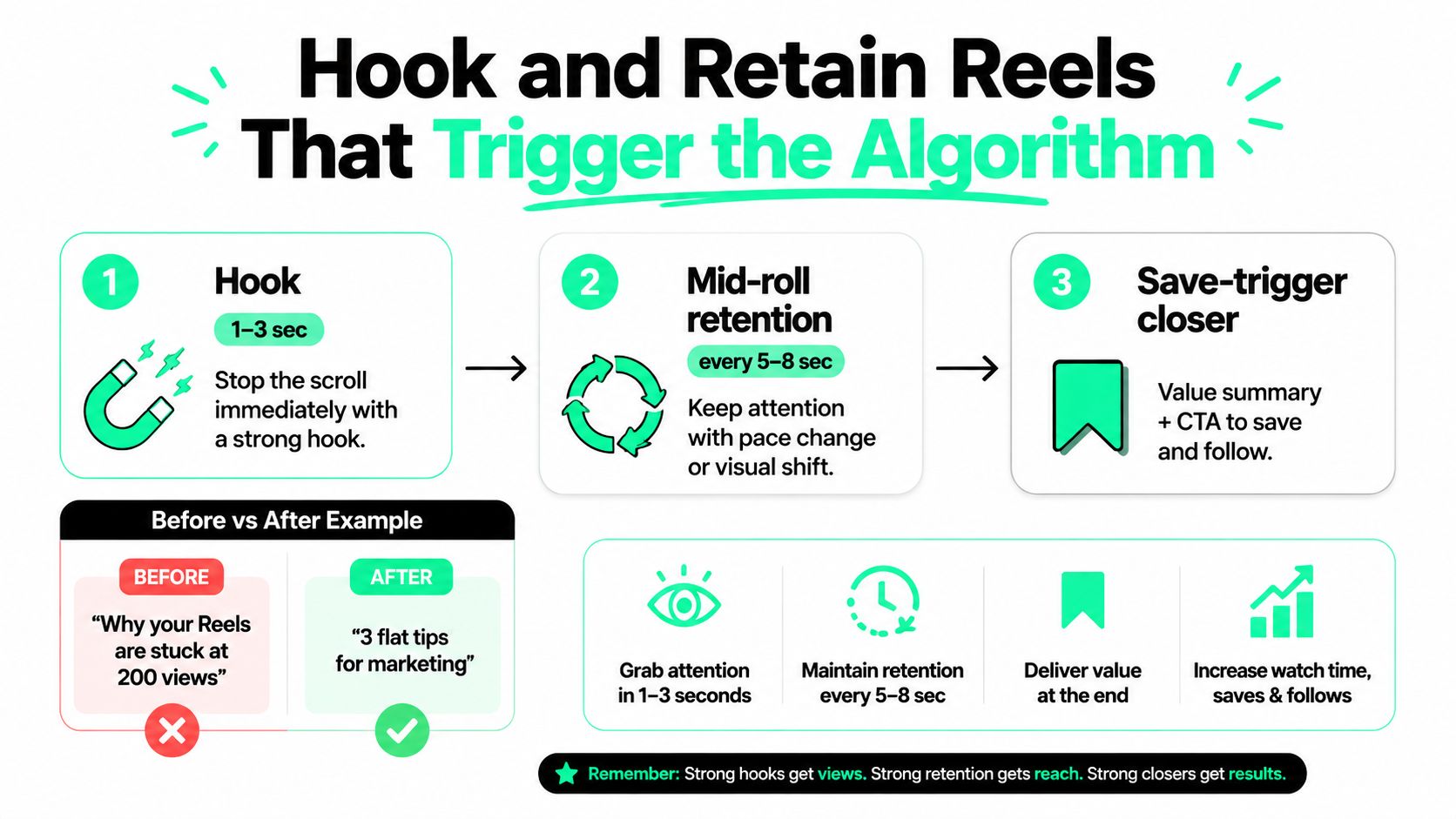
A Reel usually gets judged in three moments. The first **1 to 3 seconds** decide whether people stay. The middle every **5 to 8 seconds** decides whether they keep watching. The ending decides whether they save it, send it, or move on.
### Rewrite the opening for tension
A flat opener like “3 tips for better sleep” usually sounds informational, but not urgent. A stronger version reads more like, **“Stop sleeping like this, your brain is fighting you.”** That version creates friction, and friction keeps attention long enough for the next scene to matter.
The same idea applies to on-screen text. If the spoken hook is good but the first frame looks generic, the Reel still loses momentum. The caption, the title card, and the first visual all need to say the same thing, fast.
The best Reels workflow pages usually stress this too, and ProdShort's [2026 Instagram Reels workflow tips](https://prodshort.com/blog/instagram-reels-best-practices) line up with that reality, because the opening frame and early pacing matter more than polished editing alone.
### Keep the viewer moving
Retention drops when the video feels static. A clean fix is to change something visually every few seconds, zoom, angle, crop, text placement, or b-roll layer. That creates a rhythm without making the edit feel frantic.
> A Reel doesn't need to be noisy. It needs enough movement that the viewer's attention doesn't have time to drift.
A save-worthy closer should feel like a useful summary, not a generic “follow for more.” Checklists, quick recaps, and compact frameworks work because they give the viewer a reason to keep the post. That is where **saves** start to matter as a growth signal, because a Reel that gets bookmarked tends to look more useful to the platform than one that only gets shallow attention.
For a deeper look at hook design, the internal breakdown [The Science of Scroll-Stopping Video Hooks](https://www.blitzreels.com/blog/the-science-of-scroll-stopping-video-hooks) is the most relevant companion read. It matches the same mechanic here, the hook isn't a slogan, it's the moment the viewer decides whether the rest of the clip deserves a second glance.
## Captions, Hashtags, and On-Screen Text That Convert Views to Follows
A Reel can have a strong visual hook and still underperform if the packaging doesn't help silent viewers and casual scrollers understand why they should stay. Around **85% of social video is watched muted**, which makes captions and on-screen text a conversion layer, not a decorative extra. The video has to read well even when the audio is off.
### Use a three-part caption structure
The caption should do three things, open with a hook line, deliver a fast value summary, then end with a soft CTA. A caption like “Your sleep issue may be coming from this one habit. Watch the clip for the fix, then save it if you want the checklist later.” works because it mirrors the Reel itself instead of repeating generic promotion.
That same structure becomes much easier to produce inside a workflow tool. With BlitzReels, one recording can be uploaded, auto-transcribed, turned into a bold caption preset with emoji callouts, and then paired with hashtags based on the pillar. It's a practical shortcut for creators who need the same post to work on multiple surfaces without rewriting everything from scratch.
### Layer hashtags by role, not by volume
Hashtags still need a logic stack. A **broad** tag helps place the topic in a larger category, a **niche** tag narrows it to the relevant audience, and a **community** tag signals the subculture or recurring interest group that should care.
That doesn't mean stuffing every caption with random labels. The more important piece is topical relevance, because irrelevant tags dilute the signal and make the post feel assembled instead of deliberate.
### Make on-screen text do real work
On-screen text should support the hook, not paraphrase the entire script. For a Reel about sleep, that might mean one line for the problem, one line for the turning point, and one line for the takeaway. The viewer should be able to understand the clip even if they tap through with the sound off.
A useful moderation habit also belongs here. If a post starts attracting cluttered or distracting comments, Exerta's [step-by-step comment moderation](https://exerta.ai/blog/how-to-hide-instagram-comments) can help keep the thread clean enough that real replies aren't buried. That matters because comments can shape how new visitors read the post, especially when the topic is sensitive or polarizing.
For a tighter breakdown of caption mechanics, the internal guide on [how captions drive engagement on TikTok and Instagram](https://www.blitzreels.com/blog/how-captions-drive-engagement-on-tiktok-and-instagram) is a smart adjacent resource. The same principle applies here, captions don't rescue weak content, but they absolutely help strong content convert better.
## Posting Cadence and Cross-Posting Without Cannibalizing Reach
A steady **3 to 5 Reels per week** gives Instagram enough repeated signals to learn which hooks, topics, and edits hold attention. Buffer's analysis of **52 million+ posts** from **200,000+ accounts** found that posting **3 to 5 times per week** is associated with roughly **2× faster follower growth** than posting **1 to 2 times per week**, and it also reported that **Instagram Reels generate 36% more reach** than other post types ([Buffer analysis](https://buffer.com/resources/grow-on-instagram/)).
### Repurpose one recording into multiple cuts
A repurposing-first workflow keeps that cadence realistic. One long recording on Monday can become several short clips by Friday if the edit process is built around clipping, reframing, resizing, and caption restyling instead of starting from zero every time.
BlitzReels supports that kind of pipeline through its AI editing, auto-reframing, subtitle generation, and short-form export flow, which is useful when the same source video needs to become a vertical Instagram Reel, a TikTok cut, or a YouTube Shorts version. It also fits the way short-form growth works, because the same recording can produce different hooks, pacing, and on-screen text without forcing a fresh shoot for every platform. For teams planning that kind of rollout, [multi-platform publishing](https://www.blitzreels.com/glossary/multi-platform-publishing) is the practical model, since the source stays the same while the packaging changes.
### Cross-post without making every platform look identical
Cross-posting works best when the core idea stays the same and the presentation changes by platform. TikTok and Instagram Reels can often share the same clip with different captions, while LinkedIn usually deserves a cleaner, more business-aware cut. Watermarks, awkward crops, and platform-specific text formatting are the main places repurposing breaks down, and those mistakes make a clip feel recycled instead of native.
A simple week can look like this:
- **Monday:** record one source video and mark the strongest sections.
- **Tuesday:** cut the first two Reels, each with a different hook.
- **Wednesday:** reframe the best clip for a second platform.
- **Thursday:** build a version with a new title card and caption style.
- **Friday:** publish the final clip and compare which opener held attention longer.
Native packaging matters more than volume. The same footage can travel well, but the caption, framing, and title card still need to match the feed where the clip lands.
## Engagement Workflows That Compound Discovery
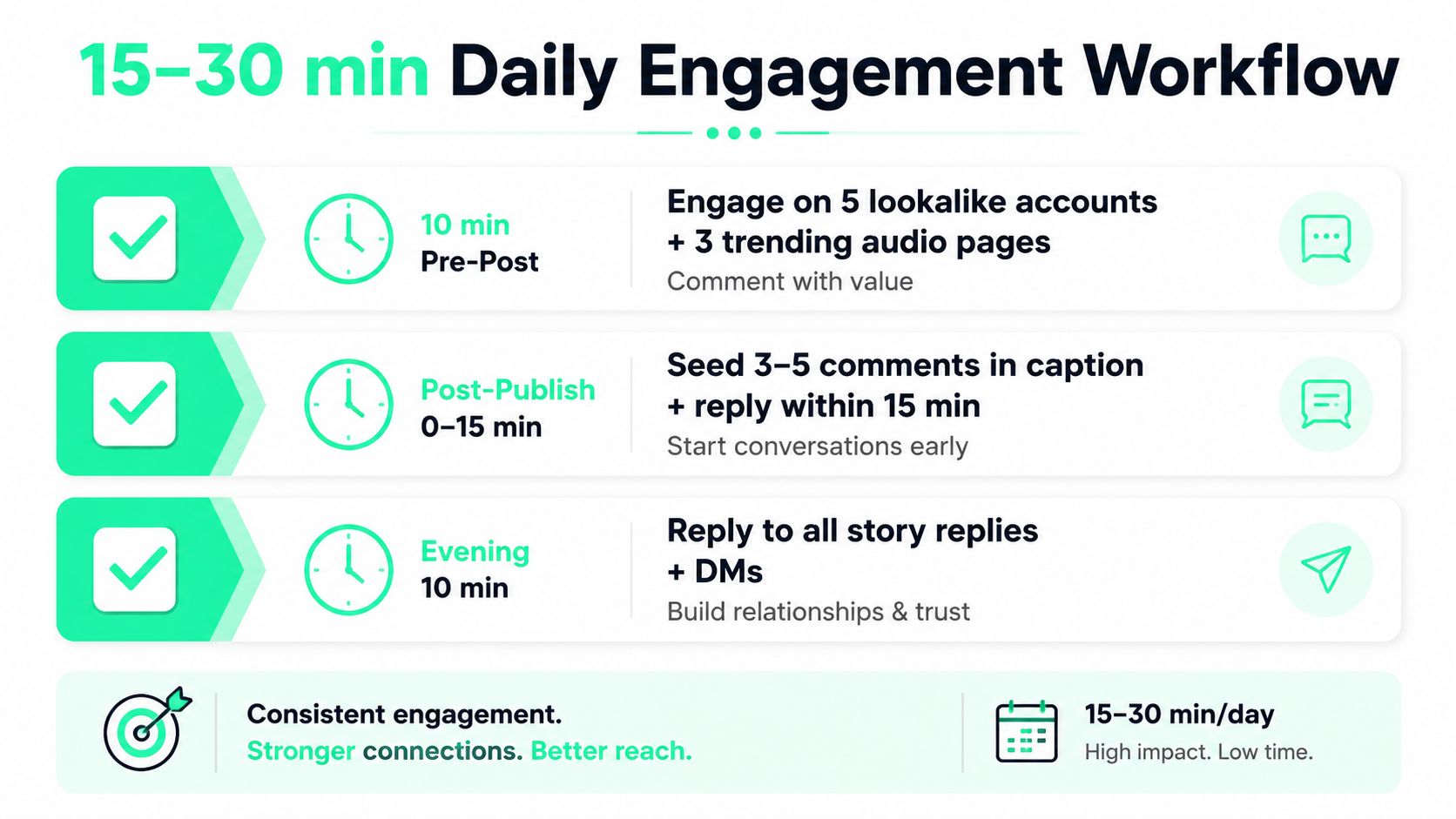
Organic growth gets easier when engagement is scheduled like production, not treated like a vague social habit. A **15 to 30 minute daily block** is enough to keep the account visible in the right circles if it's used with intent, and one 2026 guide recommends engaging **before and after posting**, replying to all comments within **1 hour**, and spending **15 to 30 minutes** inside the niche as part of a repeatable workflow ([Instagram follower growth guide](https://socialrails.com/blog/instagram-follower-growth-guide)).
### Use a timed daily block
The most useful version of this block is simple. Spend the first part of the session leaving thoughtful comments on lookalike accounts and a few trending audio pages in the niche. Then publish, seed a few early comments if the caption supports conversation, and finish with a reply sweep later in the day.
That early reply window matters because it keeps the post active while the platform is testing it with early viewers. When the creator responds quickly, the thread keeps moving, and that gives the post more visible signs of relevance.
### Read the four metrics that matter
Instagram Insights can drown a creator in numbers, but only a few deserve attention for follower growth:
- **Reach:** who saw it.
- **Watch time:** who stayed.
- **Saves:** who considered it worth keeping.
- **Profile visits:** who wanted to know more.
Those four metrics tell a cleaner story than likes alone. A post with modest likes but strong saves and profile visits often points to a format worth repeating, while a high-like post with weak profile visits usually means the content entertained but didn't persuade.
### Run a clean A/B test
The fastest test is not changing everything at once. Keep the topic, the length, and the edit style the same, then change only the hook on the next Reel. If the save behavior shifts, the opener is probably doing real work.
A Friday review can stay short:
1. Note the top Reel by saves.
2. Note the top Reel by profile visits.
3. Identify the opening line that held attention.
4. Mark one format to repeat next week.
5. Drop one format that looked busy but didn't convert.
Leaving thoughtful comments on five larger accounts in the niche can also help, but only if the comments sound like a real human is present, not a growth bot. That kind of visibility doesn't replace content quality; it keeps the account inside the conversation while the Reels do the heavy lifting.
## A 30, 60, and 90 Day Posting Plan
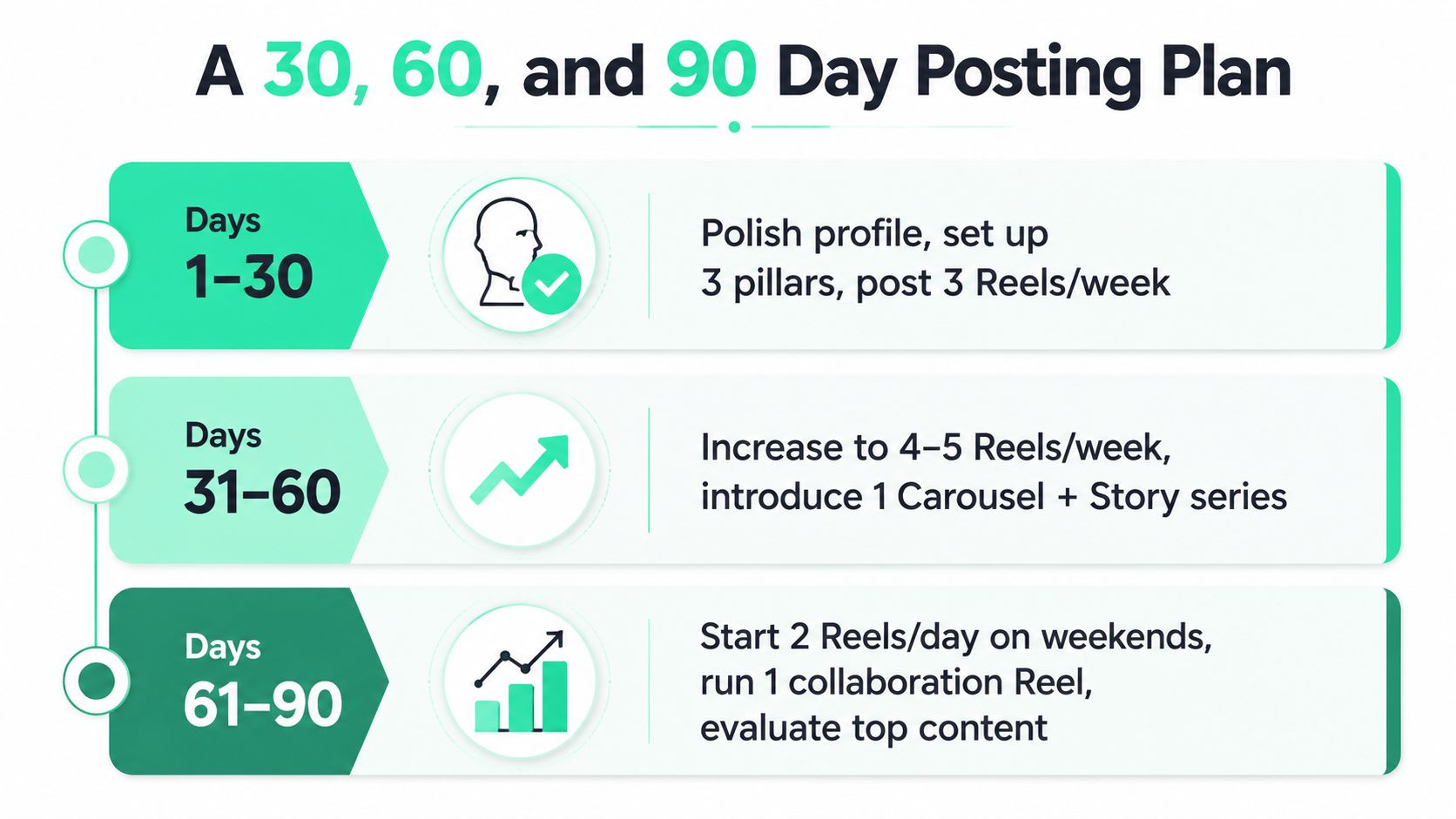
The first month should feel deliberately small. The focus is on profile polish, pillar setup, and baseline data, not on chasing a dramatic spike. A creator who posts **3 Reels per week** and tightens the bio, name field, and grid presentation can already learn which topics earn the most profile visits and which ones get ignored.
### Days 1 to 30
This window should be about structure. Set **3 content pillars**, post steadily, and look for the first signs of pattern recognition in the comments and saves. The goal isn't scale yet, it's making sure strangers understand the account in a few seconds and then choose to stay.
The best use of the daily engagement block is consistency. Short, focused activity around the niche will usually do more than random scrolling, because it keeps the account close to the right people while the Reel library starts to build.
### Days 31 to 60
By now, the account should have enough evidence to test harder. Move into **4 to 5 Reels per week**, introduce collaborations or duets where they fit naturally, and start varying hooks more aggressively while keeping the core pillar constant.
This is also the point to compare Reels by **saves, watch time, reach, and profile visits**. A post that gets attention but doesn't move profile visits is probably too loose, while a post that gets fewer views but strong saves may be the format with actual follow intent.
### Days 61 to 90
The last phase is about locking in what works and dropping what doesn't. Keep the top two pillar formats, scale toward **5 Reels per week**, and add cross-posting to TikTok and YouTube Shorts when the clip can be reformatted cleanly.
For creators who want to systematize the back catalog, the internal [back catalog clip planner](https://www.blitzreels.com/guide/back-catalog-clip-planner) is relevant here because it helps identify source footage that can still produce new shorts. That keeps the content engine from stalling once the first batch of ideas is exhausted.
A realistic 90-day win is simple. The account should know which hooks hold attention, which pillars create saves, and which posts turn strangers into profile visitors. At that point, growth stops feeling random, because the system has enough proof to repeat.
---
BlitzReels helps creators turn one recording into multiple short-form edits with captions, clipping, resizing, reframing, and export-ready vertical formats for Reels, TikTok, and Shorts. If the goal is to grow Instagram organically with a repeatable short-form workflow, [BlitzReels](https://blitzreels.com) gives that record, edit, and repurpose loop a faster path to publication.