---
title: "Short Form Content Marketing: The Complete 2026 Playbook"
canonical: "https://blitzreels.com/blog/short-form-content-marketing"
---
# Short Form Content Marketing: The Complete 2026 Playbook
URL: https://blitzreels.com/blog/short-form-content-marketing
Markdown URL: https://blitzreels.com/blog/short-form-content-marketing.md
Published: 2026-08-16
Author: BlitzReels
Master short form content marketing with platform-specific strategies, creative frameworks, and scaling workflows that drive real engagement and ROI in 2026.
Tags: short form content marketing, short video strategy, TikTok marketing, Reels strategy, video repurposing

Short-form video is no longer a test channel. YouTube Shorts reportedly passed **200 billion daily views by early 2026**, compared with **70 billion in March 2024**, while short-form video views grew **36% year over year in 2025** according to an industry summary ([short-form content statistics](https://www.shno.co/marketing-statistics/short-form-content-statistics)). The opportunity is enormous, but so is the operational problem: every brand now has access to the same vertical canvas, trending sounds, templates, and editing apps.
Winning short form content marketing therefore depends less on publishing more clips and more on making each asset feel native, understandable, and worth finishing. The practical advantage comes from sharper hooks, cleaner captions, platform-specific reframing, disciplined repurposing, and a production system that can maintain quality when the feed gets crowded.
## Table of Contents
- [Why Short Form Content Marketing Dominates in 2026](#why-short-form-content-marketing-dominates-in-2026)
- [Attention is abundant, differentiation isn't](#attention-is-abundant-differentiation-isnt)
- [Volume needs an editorial filter](#volume-needs-an-editorial-filter)
- [Platform-Specific Strategies for TikTok, Reels, and Shorts](#platform-specific-strategies-for-tiktok-reels-and-shorts)
- [TikTok and Reels need different openings](#tiktok-and-reels-need-different-openings)
- [Shorts has a strict shape requirement](#shorts-has-a-strict-shape-requirement)
- [The Hook-Pacing-Caption Framework for Retention](#the-hook-pacing-caption-framework-for-retention)
- [Start with a promise](#start-with-a-promise)
- [Keep the middle moving](#keep-the-middle-moving)
- [End with one next action](#end-with-one-next-action)
- [Mapping Short Form Content to Your Marketing Funnel](#mapping-short-form-content-to-your-marketing-funnel)
- [Awareness needs reach and recognition](#awareness-needs-reach-and-recognition)
- [Consideration needs evidence](#consideration-needs-evidence)
- [Conversion needs context](#conversion-needs-context)
- [Repurposing Workflows That Maintain Platform Quality](#repurposing-workflows-that-maintain-platform-quality)
- [Find moments worth rebuilding](#find-moments-worth-rebuilding)
- [Batch the mechanical work](#batch-the-mechanical-work)
- [Measuring What Matters in Short Form Performance](#measuring-what-matters-in-short-form-performance)
- [Use a layered scorecard](#use-a-layered-scorecard)
- [A Sample Week of Short Form Content Production](#a-sample-week-of-short-form-content-production)
- [Monday builds the queue](#monday-builds-the-queue)
- [Tuesday captures source material](#tuesday-captures-source-material)
- [Wednesday and Thursday finish assets](#wednesday-and-thursday-finish-assets)
- [Friday reviews the evidence](#friday-reviews-the-evidence)
## Why Short Form Content Marketing Dominates in 2026
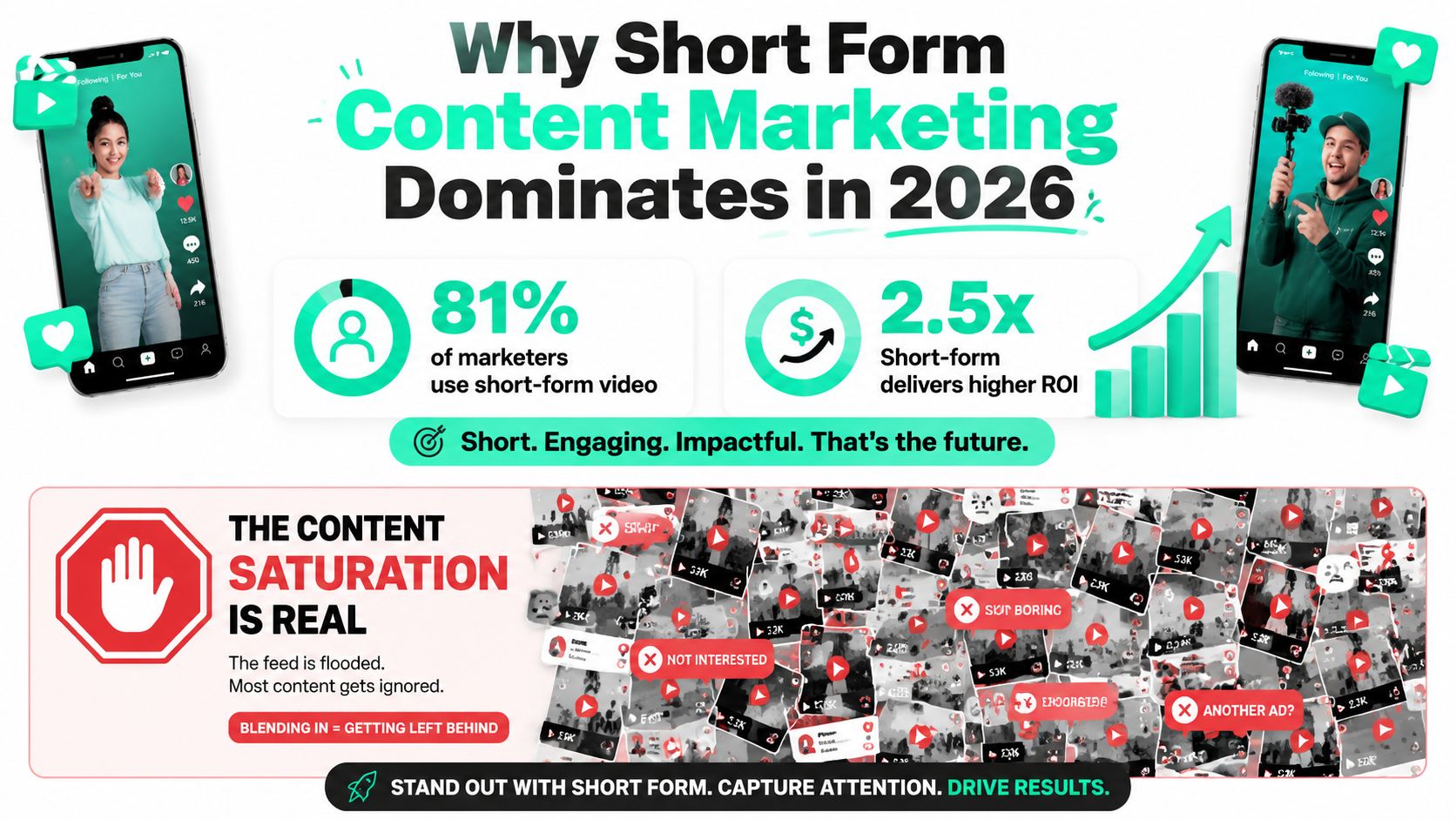
Short-form video now functions as core distribution infrastructure across TikTok, Instagram Reels, and YouTube Shorts. HubSpot's 2026 marketing data identifies it as the most popular format among marketers and the format marketers associate with the highest ROI. Industry reporting also indicates that short-form video has become a dedicated budget category for many marketing teams, as summarized in these [short-form content statistics](https://www.shno.co/marketing-statistics/short-form-content-statistics).
The budget shift reflects an operational advantage. Short clips combine mobile-native framing, rapid feedback, and flexible distribution. One recording can produce an educational hook, product demonstration, founder opinion, and customer-answer clip, provided each version receives its own opening, crop, captions, and pacing. That makes the format useful for organic discovery and paid creative testing, while reducing the cost of generating multiple creative angles.
### Attention is abundant, differentiation isn't
Industry summaries report stronger engagement for short-form video than long-form social content. They also indicate that consumers often prefer short videos when researching products or services, and that many want brands to publish more of them ([short-form video marketing statistics](https://reelflood.com/blog/short-form-video-marketing-statistics-2026)).
Demand does not guarantee reach. Recent reporting found substantial year-over-year growth in short-form posts and in the number of accounts using the format, with TikTok posting activity rising sharply ([Metricool short-form video report coverage](https://www.marketingtechnews.net/news/what-the-data-tells-us-about-short-form-video-insights-from-metricools-2025-state-of-short-form-video-report/)). More supply means a polished clip can still disappear if the first frame lacks context or the edit delays the payoff.
The saturated feed exposes generic production quickly. A podcast excerpt without setup, a logo-heavy title card, or a copied trend without a clear brand point may earn impressions without building recognition. Teams need a [repeatable social media growth system](https://mallary.ai/blog/how-to-go-viral-on-social-media) that connects content themes, publishing choices, and iteration, rather than treating each post as an isolated bet.
### Volume needs an editorial filter
High-output teams separate production volume from publishing volume. They record and edit in batches, then release only clips with a clear audience promise, a strong opening frame, readable captions, and a reason to continue watching. The workflow should preserve clean masters, platform-specific exports, and alternate hooks, so one shoot creates usable variations without making every feed look duplicated.
Platform selection also affects the production brief. A practical comparison of TikTok, Reels, and Shorts should guide resource allocation because each surface has different audience behavior, search value, and native editing expectations ([platform comparison for creators](https://blitzreels.com/blog/reels-tiktok-or-shorts-which-platform-is-best-for-creators-in-2026)).
> **Practical rule:** More posts create more chances to learn, but undifferentiated posts can train an audience to scroll past the brand.
## Platform-Specific Strategies for TikTok, Reels, and Shorts
A short video isn't automatically platform-native because it has a vertical crop. Native execution includes the opening line, text placement, pacing, sound treatment, metadata, and visual context.
One benchmark set reports median organic engagement of **5.2% for TikTok-native short video**, **2.3% for Instagram Reels**, **0.9% for Facebook short video**, and **1.1% for repurposed low-context clips** ([organic short-form video benchmarks](https://www.benchmarketing.org/benchmarks/organic-social/short-form-video)). The gap makes a strong operational point: auto-reframing and resizing matter, but the hook must also be rewritten for the destination platform.
| Platform | Aspect Ratio | Median Engagement | Key Algorithmic Signal |
|---|---:|---:|---|
| TikTok | Vertical 9:16 | 5.2% for TikTok-native short video | Early watch time, native formatting, and interaction |
| Instagram Reels | Vertical 9:16 | 2.3% | Retention, shares, saves, and visual consistency |
| Facebook short video | Vertical-first | 0.9% | Watch behavior and audience relevance |
| Repurposed low-context clips | Often inconsistent | 1.1% | Weak context and compressed distribution |
| YouTube Shorts | Vertical 9:16 | Not listed in this benchmark set | Completion, watch time, and Shorts eligibility |
| LinkedIn video | Platform-native vertical or square exports | Not listed in this benchmark set | Professional relevance, clear framing, and discussion |
### TikTok and Reels need different openings
TikTok can support a more direct, conversational start. A creator may open with the result, a contrarian observation, or a fast demonstration before explaining the background. Reels often benefits from a cleaner visual system, stronger cover design, and a hook that makes sense to an existing community as well as non-followers.
Both platforms need clean exports without distracting cross-platform watermarks. Teams evaluating brand marks, export overlays, and attribution should understand [how short-form video watermarks work](https://findclout.com/blog/posts/watermark-advertising-explained-always-on-brand-watermarks-in-short-form-video.html), particularly when a clip will be distributed across several feeds.
For teams producing regular TikTok assets, a dedicated [TikTok video workflow](https://blitzreels.com/use-cases/tiktok-videos) can keep captions, framing, and export settings consistent without forcing every clip through the same creative template.
### Shorts has a strict shape requirement
YouTube Shorts uses a vertical **9:16** format. Videos that are at least square or taller than square can qualify for the Shorts shelf, while horizontal **16:9** video doesn't qualify even when the runtime is short. The commonly used working canvas is **1080 by 1920 pixels**, as described in [YouTube Shorts format guidance](https://virlo.ai/blog/how-long-can-youtube-shorts-be).
LinkedIn deserves separate treatment. A podcast clip that works on TikTok may need a stronger professional premise, less trend-dependent audio, and a title card that states the business implication. The footage can be reused, but the packaging shouldn't be copied without adaptation.
## The Hook-Pacing-Caption Framework for Retention
Retention is built in the edit. Viewers must grasp the premise quickly, follow a clear visual sequence, and keep deciding that the next moment deserves attention. At scale, that requires an editing system, not a different instinct for every clip.
A short video needs a job for every second. Avoid compressing a useful explanation to chase a shorter runtime. Review the cut for delayed context, repeated points, dead air, and visuals that do not advance the idea.
### Start with a promise
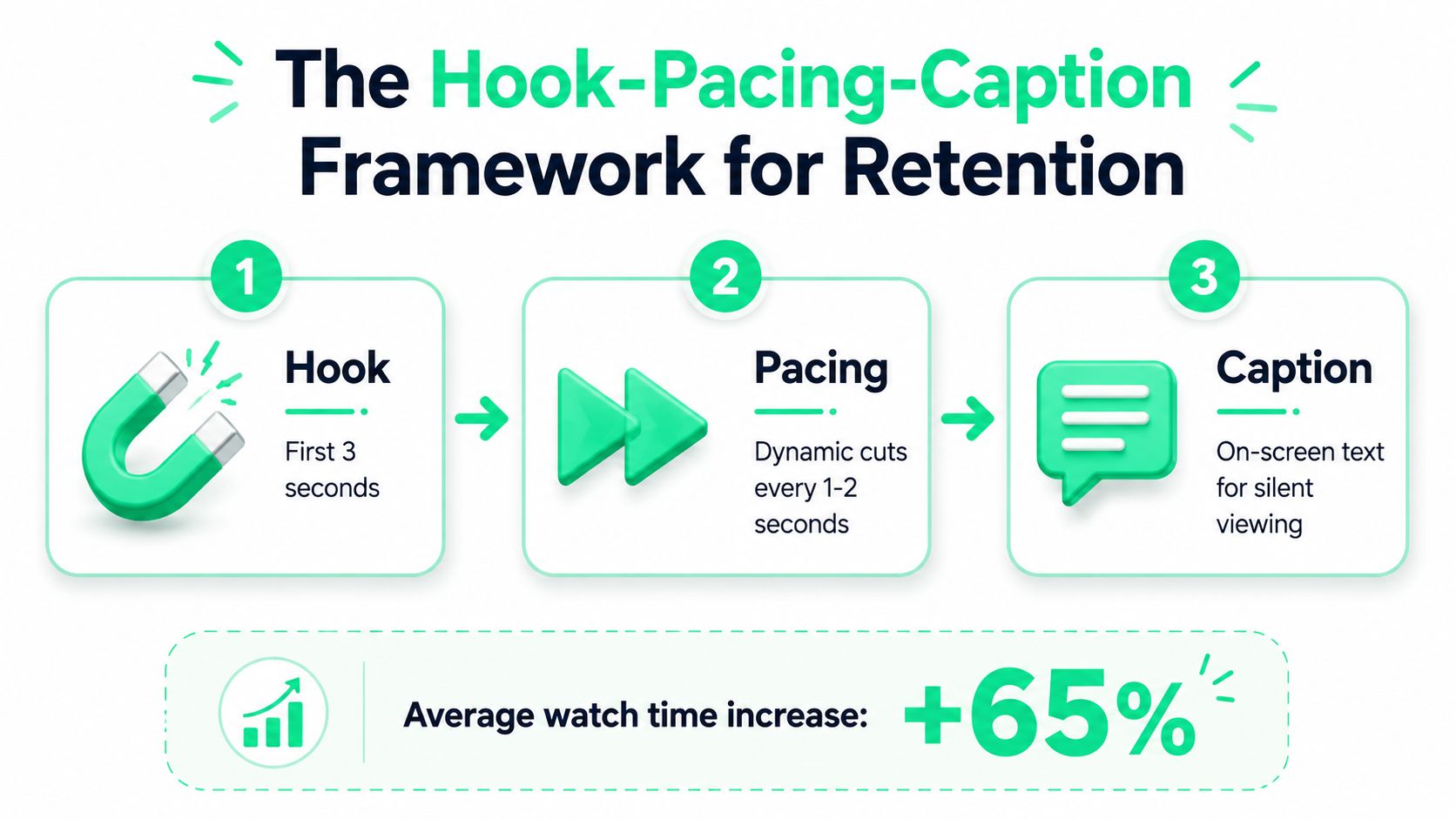
The opening should answer **why should this viewer keep watching?** before the viewer has time to scroll. Strong hooks usually take one of four forms:
- **State the result:** Show the finished outcome before explaining the process.
- **Name the problem:** Identify a costly mistake, confusing step, or familiar frustration.
- **Create a contradiction:** Challenge an assumption held by the intended audience.
- **Show motion:** Start with the transformation, action, or visual proof instead of a greeting.
Remove logo animations, “welcome back,” and long introductions unless they deliver context immediately. A title card earns its place when the benefit is clear, the wording is brief, and the type remains readable on a small screen. For more opening structures, use this guide to the [science of scroll-stopping video hooks](https://blitzreels.com/blog/the-science-of-scroll-stopping-video-hooks).
### Keep the middle moving
Pacing does not require every shot to last the same amount of time. Cut silence, repeated explanations, weak transitions, and visual pauses that add no meaning. Jump cuts, punch-ins, B-roll, screen recordings, and callouts should clarify the argument. Decorative motion adds workload without necessarily improving retention.
Captions have a separate job. Research reports that viewers were **80% more likely to watch an entire video when captions were present**, and notes that **85% of videos are watched without sound** ([captioned video research](https://sinc-lab.com/files/nguyen2026like.pdf)). Burn captions into the export with strong contrast, readable line breaks, and timing that follows speech closely. Check safe areas separately for TikTok, Reels, and Shorts, since interface elements can cover text near the edges.
A 2022 study of brand TikTok videos found that captions, title length, screen mode, human voice, and music significantly influenced consumer engagement ([TikTok caption and engagement study](https://dalspace.library.dal.ca/items/146e80b1-8edb-4090-b5b1-79c6324085d1)). Caption design affects comprehension before it affects polish, so treat it as part of the edit rather than a final overlay.
### End with one next action
Complete the promise, then give viewers one clear action. They might save the post, watch a longer explanation, visit a product page, or answer a specific question in the comments. Choose the action that matches the clip's purpose. Competing calls to action make the ending feel unfinished and dilute the result you are trying to measure.
## Mapping Short Form Content to Your Marketing Funnel
Short-form video performs differently across the funnel. It often creates the first touch or the strongest early signal, but it doesn't automatically provide the depth required for every buying decision.
HubSpot's 2025 marketing data reports that **21% of marketers say short-form video delivers the highest ROI**, while **17.13% say it is the format they plan to invest more in** ([HubSpot video marketing statistics](https://blog.hubspot.com/marketing/video-marketing-statistics)). Those figures support a qualified conclusion. Short-form is commercially valuable, but it isn't a universal replacement for product education, comparison content, demos, documentation, or sales conversations.
### Awareness needs reach and recognition
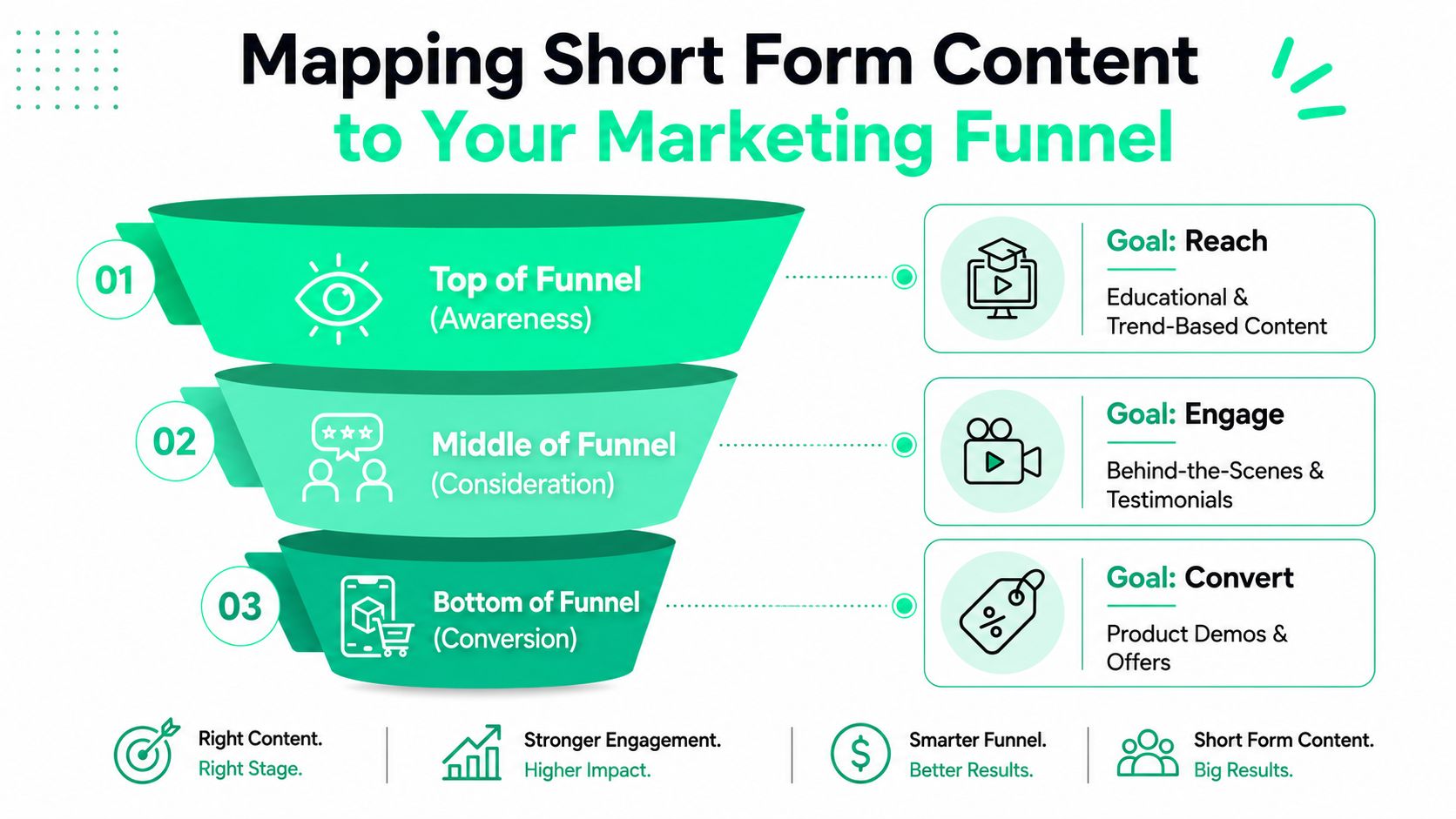
Top-of-funnel clips should make the audience understand the topic and the brand's point of view quickly. Educational mini-lessons, trend-aware commentary, myth corrections, and visual demonstrations work well because viewers can benefit without knowing the brand beforehand.
The KPI is not only views. Watch behavior, shares, profile visits, and qualified comments reveal whether the topic attracted the right people. A broad entertainment clip may reach more viewers than a narrow product problem, but the narrower clip can create stronger audience relevance.
### Consideration needs evidence
Middle-funnel video should answer the questions that prevent action. Behind-the-scenes footage can show process. A testimonial can introduce a result, provided it doesn't make unsupported claims. A comparison clip can clarify who a product suits and who should choose another approach.
This stage often benefits from a sequence rather than a single post. One clip can frame the problem, another can demonstrate the workflow, and a longer page or video can handle the details that a fast feed cannot.
### Conversion needs context
Bottom-of-funnel clips can show a product in use, explain a specific feature, address an objection, or present an offer. The edit should become clearer, not louder. A viewer who is close to conversion usually needs proof, terms, and a simple next step more than a fast montage.
> Short-form video can open the door, but deeper assets often help the buyer decide whether to walk through it.
For consumer products, a short demonstration may be enough to prompt a visit. For complex services or B2B software, a hybrid system is safer: use short clips for discovery, then connect them to a landing page, full demonstration, case evidence, or direct conversation.
## Repurposing Workflows That Maintain Platform Quality
Repurposing fails when teams treat it as file conversion. A horizontal interview placed inside a vertical frame, with the original introduction removed and no replacement context, is technically a short but editorially incomplete.
A better workflow begins with the source asset. Webinars, podcasts, interviews, product walkthroughs, and screen recordings contain multiple ideas, but each finished clip should communicate one point without requiring the viewer to know the original conversation.
### Find moments worth rebuilding
Transcription helps editors search for claims, questions, objections, and memorable explanations instead of scrubbing through an entire recording. The selected moment then needs a new opening line, a clean in-point, and an ending that feels intentional.
The workflow can be organized as follows:
1. **Mark the source:** Identify sections with a complete thought, useful tension, visible emotion, or demonstrable result.
2. **Write the new hook:** Replace the original conversational setup with a direct title card or spoken opening.
3. **Build the vertical composition:** Reframe faces, screens, products, and supporting footage so the main subject remains legible.
4. **Add captions:** Correct the transcript, emphasize key terms, and keep text away from platform interface areas.
5. **Create platform variants:** Adjust the opening, caption density, title card, sound treatment, and call to action for TikTok, Reels, Shorts, LinkedIn, or other destinations.
6. **Review the silent version:** Watch without audio and confirm that the argument still makes sense.
### Batch the mechanical work
Fast editing comes from standardizing repetitive decisions without standardizing every idea. Templates can lock brand colors, caption styles, safe areas, and end cards, while editors still choose different hooks and visual rhythms for each clip.
Automated content repurposing can also be useful for technical teams that need to convert recorded material into channel-specific assets, as described in this guide to [automated content repurposing for developers](https://post-pulse.com/blog/content-repurposing-strategy). The important distinction is review. Automation can surface candidate clips and generate captions, but a human still needs to check context, accuracy, pacing, and whether the opening makes sense to a cold viewer.
A platform-focused workflow such as [repurposing long videos with AI](https://blitzreels.com/blog/how-to-repurpose-long-videos-with-ai) can reduce manual clipping and reframing work. BlitzReels is one option that transcribes recordings, detects potential cuts, generates captions, keeps faces centered through auto reframing, and exports vertical versions for major short-form platforms.
## Measuring What Matters in Short Form Performance
Views show distribution, not business impact. A useful measurement system separates **attention**, **interaction quality**, and **downstream action**, then connects each layer to a production decision.
Retention exposes problems in the edit. If viewers leave before the premise becomes clear, changing the final call to action will not rescue the clip. If they finish without responding, the topic may be clear but lack enough practical or commercial value to prompt action.
### Use a layered scorecard
- **Opening retention:** Check whether viewers stay through the hook and first explanation. An early drop often points to weak framing, a slow setup, or missing context. Test a tighter first cut before rewriting the entire script.
- **Completion behavior:** Videos under **90 seconds** have been reported to retain about **50% of viewers on average**. Use that benchmark only as directional context, alongside each platform's own analytics.
- **Quality interactions:** Shares, saves, thoughtful comments, profile visits, and direct replies usually signal more intent than passive likes. Tag these actions by topic and format so editors can see which creative choices produce them.
- **Business actions:** Track relevant page visits, sign-ups, demo requests, purchases, and assisted conversions with consistent campaign names and destination links. A clip can succeed commercially without generating the highest view count.
- **Audience quality:** Review who watched and acted. Reach from the wrong audience can inflate top-line results while producing little commercial value.
The [video analytics glossary](https://blitzreels.com/glossary/video-analytics) gives teams shared definitions for retention, completion, engagement, and conversion. That consistency matters when editors, channel managers, and demand teams review the same clip.
Attribution remains imperfect. A viewer may watch a clip, search for the brand later, and convert through another channel. Compare content families, opening styles, topics, audience segments, and platform variants over time. Keep the patterns that combine strong watch behavior with meaningful follow-up, then revise or retire clips that only generate surface-level reach.
## A Sample Week of Short Form Content Production
A sustainable production week separates creative decisions from repetitive editing. The team plans the ideas first, records related material in batches, then adapts finished clips for each platform instead of starting from scratch every day.
### Monday builds the queue
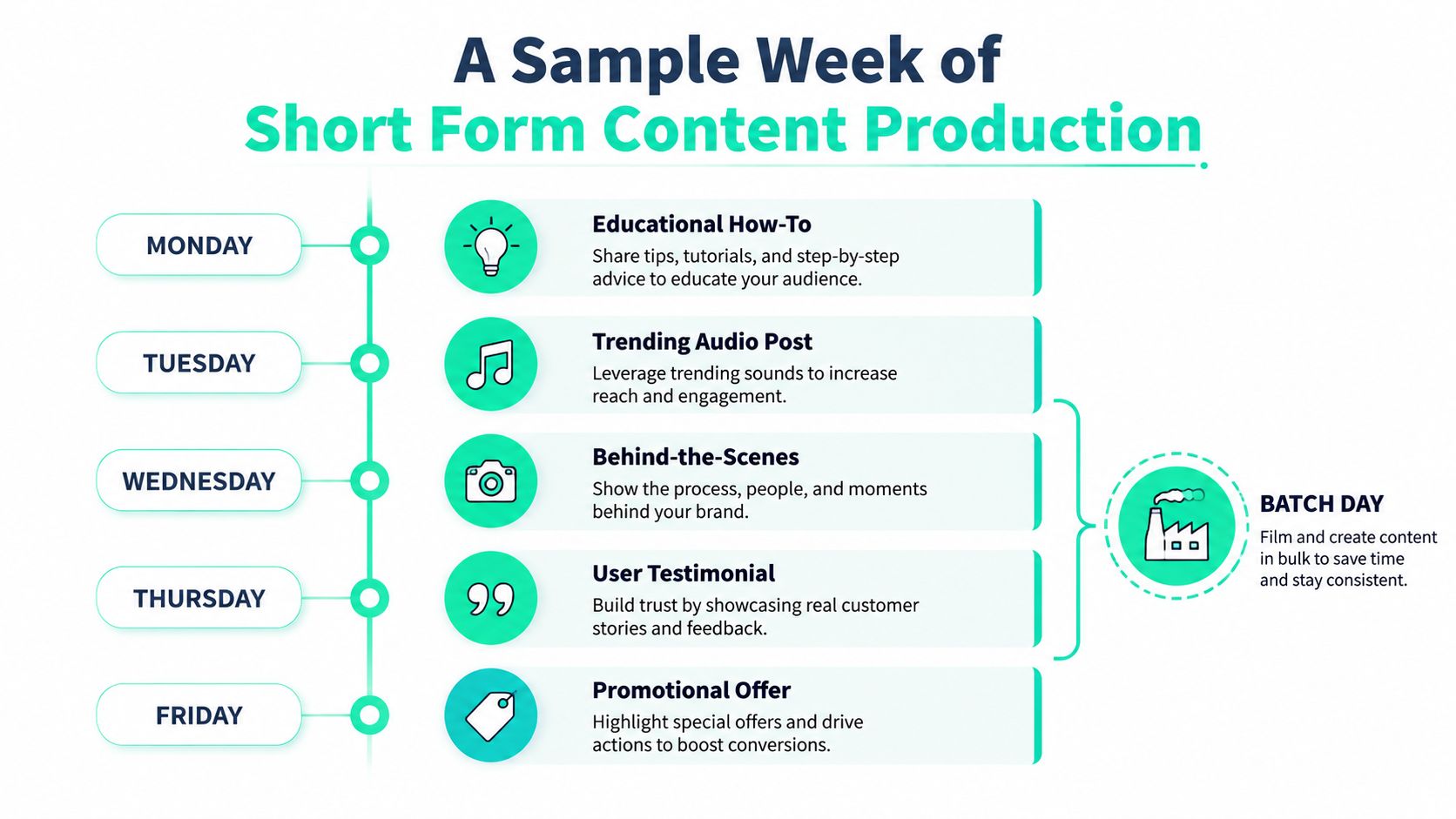
Monday is for reviewing recent performance, selecting themes, and writing hooks. A small team might choose an educational how-to, a product objection, a customer question, a behind-the-scenes moment, and a promotional explanation.
Each idea gets a single intended viewer and a single action. The script can be brief, but the opening line, visual proof, caption treatment, and destination should be decided before filming.
### Tuesday captures source material
Tuesday is the recording day. The team can film direct-to-camera explanations, screen demonstrations, product close-ups, and alternate hook takes in the same session. Capturing clean pauses between ideas makes later clipping easier, while recording multiple framings creates more options for vertical reframing.
A producer should also capture supporting footage. Hands using a product, a screen interaction, a workspace detail, or a presenter reacting to a result can cover jump cuts and make repurposed clips feel authored rather than extracted.
### Wednesday and Thursday finish assets
Wednesday is for selecting moments, trimming dead air, arranging clips, adding captions, and applying title cards. Thursday is for platform-specific versions, including cover frames, opening text, crop checks, sound decisions, and scheduling.
Templates should handle the repeatable visual system, but editors should still review every caption and crop. A face centered in one clip can be cut off in another, and a sentence that reads well on TikTok may need a different first frame for LinkedIn.
### Friday reviews the evidence
Friday is for comparing retention, completion, interactions, profile activity, and downstream actions. The team should record what changed between strong and weak clips: the hook, topic, speaker, framing, runtime, caption density, or call to action.
The next week's queue should reflect those observations. That creates a production loop where every batch supplies creative learning, not just another set of files.
> **Production principle:** Batch the labor, not the thinking. Repetition should make editing faster while keeping the audience promise fresh.
---
BlitzReels helps creators and marketing teams transcribe recordings, find usable clips, add captions, reframe footage, resize exports, and prepare short-form videos for TikTok, Reels, Shorts, LinkedIn, and other platforms. Visit [BlitzReels](https://blitzreels.com) to turn a repeatable short-form content marketing workflow into a faster record, edit, and publish process.