---
title: "Short Form Video: A Complete Guide for Creators in 2026"
canonical: "https://blitzreels.com/blog/short-form-video"
---
# Short Form Video: A Complete Guide for Creators in 2026
URL: https://blitzreels.com/blog/short-form-video
Markdown URL: https://blitzreels.com/blog/short-form-video.md
Published: 2026-06-01
Author: BlitzReels
Master short form video in 2026. This guide covers TikTok, Reels, & Shorts specs, a fast creation workflow, key metrics, and tools to grow your audience.
Tags: short form video, tiktok marketing, instagram reels, youtube shorts, video marketing

Short form video already runs most feeds. A creator opens TikTok for one clip, then swipes through Reels, then lands on Shorts while searching for a quick answer. A brand team records one webinar and suddenly needs six vertical cuts by tomorrow. A founder films a product update on a phone, then realizes the raw take still needs captions, reframing, title cards, and platform-specific edits before it's ready to publish.
This is the challenge. Short form video isn't hard because people don't understand the format. It's hard because the workflow breaks. Good ideas get stuck in editing. Strong footage never gets clipped. One decent post goes live, but consistency disappears because every new video starts from zero.
That's why short form video needs to be treated less like occasional creative work and more like an operating system for attention. The teams that publish consistently usually aren't guessing. They have a repeatable process for hooks, edits, captions, resizing, and distribution. They know what gets reused, what gets cut, and what needs to change from platform to platform.
For a basic reference point, [BlitzReels' short form video glossary](https://www.blitzreels.com/glossary/short-form-video) is a useful starting definition. The bigger issue is execution. That's where most creators and marketing teams lose time.
## Table of Contents
- [Introduction The Unskippable Force in Your Feed](#introduction-the-unskippable-force-in-your-feed)
- [Why the pressure feels higher now](#why-the-pressure-feels-higher-now)
- [What separates creators who stay consistent](#what-separates-creators-who-stay-consistent)
- [What Is Short Form Video and Why Does It Dominate](#what-is-short-form-video-and-why-does-it-dominate)
- [It's built for the phone first](#its-built-for-the-phone-first)
- [It dominates because the feed is competitive](#it-dominates-because-the-feed-is-competitive)
- [The Big Three TikTok vs Instagram Reels vs YouTube Shorts](#the-big-three-tiktok-vs-instagram-reels-vs-youtube-shorts)
- [Platform spec comparison](#platform-spec-comparison)
- [TikTok favors native-feeling momentum](#tiktok-favors-native-feeling-momentum)
- [Instagram Reels rewards polish with restraint](#instagram-reels-rewards-polish-with-restraint)
- [YouTube Shorts has a search advantage](#youtube-shorts-has-a-search-advantage)
- [The Anatomy of a High-Performing Short](#the-anatomy-of-a-high-performing-short)
- [The hook](#the-hook)
- [The middle](#the-middle)
- [The ending](#the-ending)
- [A Practical Workflow for Creating Shorts Quickly](#a-practical-workflow-for-creating-shorts-quickly)
- [Start with clip inventory, not just ideas](#start-with-clip-inventory-not-just-ideas)
- [Build the edit around retention points](#build-the-edit-around-retention-points)
- [Publish as variants, not duplicates](#publish-as-variants-not-duplicates)
- [Measuring What Matters Key Metrics and Performance Analysis](#measuring-what-matters-key-metrics-and-performance-analysis)
- [What the metrics actually mean](#what-the-metrics-actually-mean)
- [Match the metric to the content type](#match-the-metric-to-the-content-type)
- [The Right Tools for a Faster Workflow](#the-right-tools-for-a-faster-workflow)
- [All-in-one editors](#all-in-one-editors)
- [Caption and subtitle tools](#caption-and-subtitle-tools)
- [Repurposing tools](#repurposing-tools)
## Introduction The Unskippable Force in Your Feed
Short form video doesn't announce itself anymore. It's the default behavior of the modern feed. Someone checks Instagram for messages and ends up watching Reels. Someone opens YouTube to solve a problem and gets pulled into Shorts. Someone on a commute watches one clip with captions on mute, then another with sound on, then another because the title card made a sharper promise.
That shift changed more than content length. It changed how creators package ideas. A useful thought now has to survive the first swipe. A story has to land in a vertical frame. A lesson has to be visible before it's fully explained. The feed rewards clarity, speed, and editing discipline.
> Short form video wins when the value is visible before the viewer has time to wonder whether to keep watching.
The creators who grow in this environment usually aren't just better on camera. They're better at production decisions that look small but matter a lot. They open with a hook instead of a greeting. They burn in captions so the message still works on mute. They clip aggressively, cut dead air, and reframe shots for phones instead of hoping a horizontal video survives a vertical feed.
### Why the pressure feels higher now
The pressure comes from volume. Every platform serves endless alternatives, so weak execution gets punished fast. A slow opening, a cluttered frame, or a buried takeaway can kill an otherwise good idea.
That's also why short form video has become operational. Publishing once isn't the problem. Publishing every week without bottlenecks is the problem.
### What separates creators who stay consistent
Consistent creators usually rely on a system like this:
- **Capture reusable footage:** They record with clipping in mind, not just one finished post.
- **Edit for retention:** They add captions, title cards, cuts, and visual changes where attention usually drops.
- **Resize for distribution:** They adapt footage to each feed instead of posting the same export everywhere.
- **Build templates:** They reduce decisions on every post, which makes speed possible.
## What Is Short Form Video and Why Does It Dominate
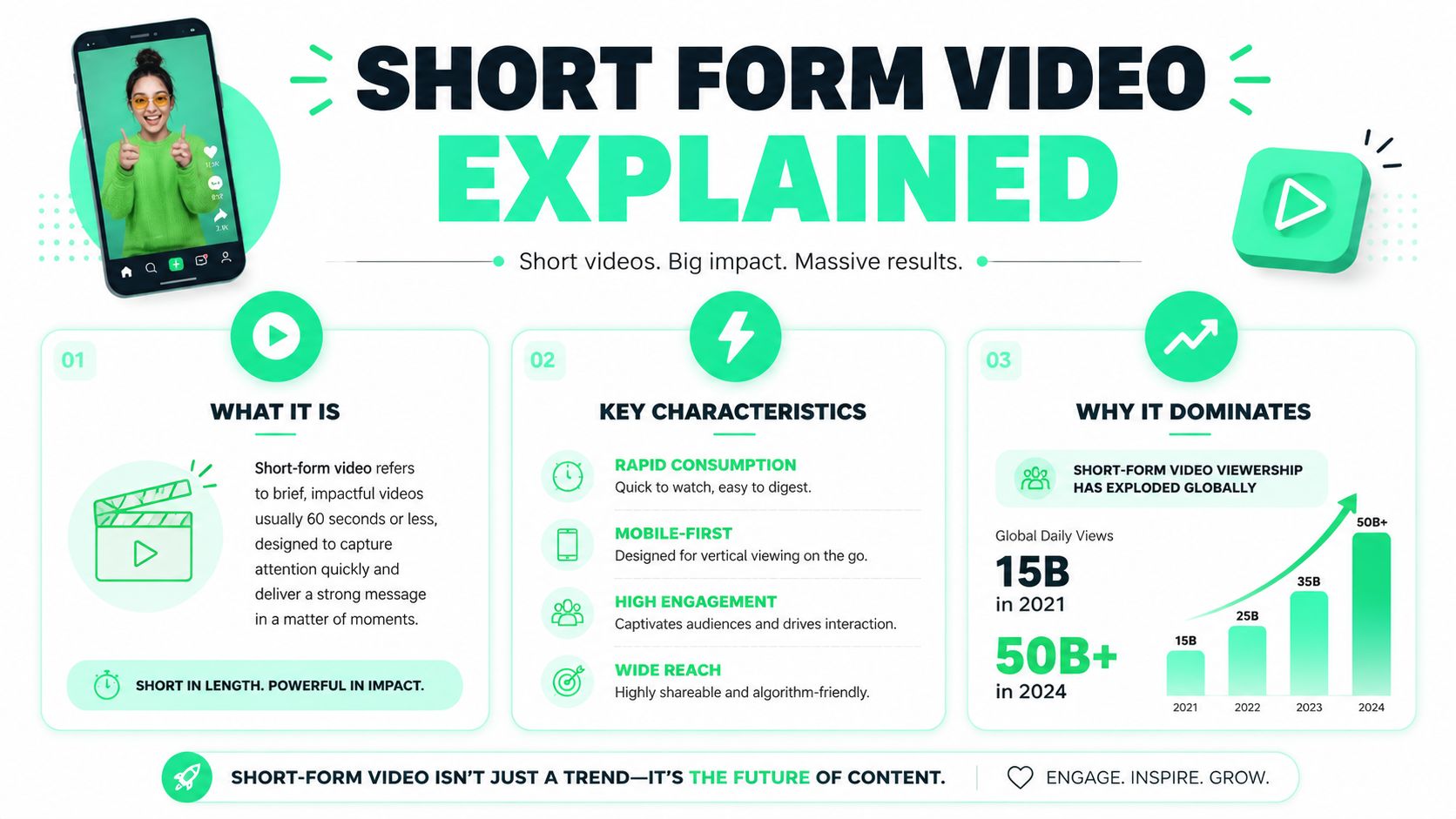
Short form video is **video designed for fast mobile consumption**, usually in a vertical feed where users decide in seconds whether to keep watching. It isn't just “a shorter video.” It's a format built around interruption, immediate clarity, and efficient delivery.
Industry reporting in 2025 noted that TikTok had **2.051 billion global users** and was projected to reach **1.8 billion monthly active users by the end of 2025**, while **90% of vertical videos** were reported to have higher watch-completion rates than horizontal videos, according to [INMA's 2025 social media trends report](https://www.inma.org/blogs/social-media/post.cfm/short-form-video-user-generated-content-are-among-top-social-media-trends-for-2025). That combination matters. Massive audience scale meets a format people are more likely to finish.
### It's built for the phone first
Short form video fits how people already hold devices. That sounds obvious, but it changes creative choices. Vertical framing makes faces larger, text easier to read, and visual context faster to understand. A viewer doesn't need to rotate the screen or commit to a long setup. The content starts where attention already is.
The same INMA reporting described short form video as typically **5 to 90 seconds** long, with **7 to 15 seconds** recommended for quick hooks and **15 to 30 seconds** for most content. That's why strong shorts feel compressed without feeling incomplete. They're edited to remove anything that delays the payoff.
### It dominates because the feed is competitive
A crowded feed punishes slow communication. The format works because it forces prioritization. The opening line, the first visual, the subtitle treatment, and the pacing all carry more weight than they do in long-form content.
A helpful companion read is [Direct AI's creator guide](https://www.directai.app/blog/short-form-video-content), especially for creators trying to think beyond “post more clips” and toward a more structured short-form strategy.
> **Practical rule:** If a video needs explanation before it becomes interesting, it usually isn't ready for short form.
Short form video also compresses testing. A creator can try multiple hooks, different title cards, alternate caption styles, and several cuts from the same source material. That's part of why the format has become so central. It's not only engaging. It's highly testable.
## The Big Three TikTok vs Instagram Reels vs YouTube Shorts
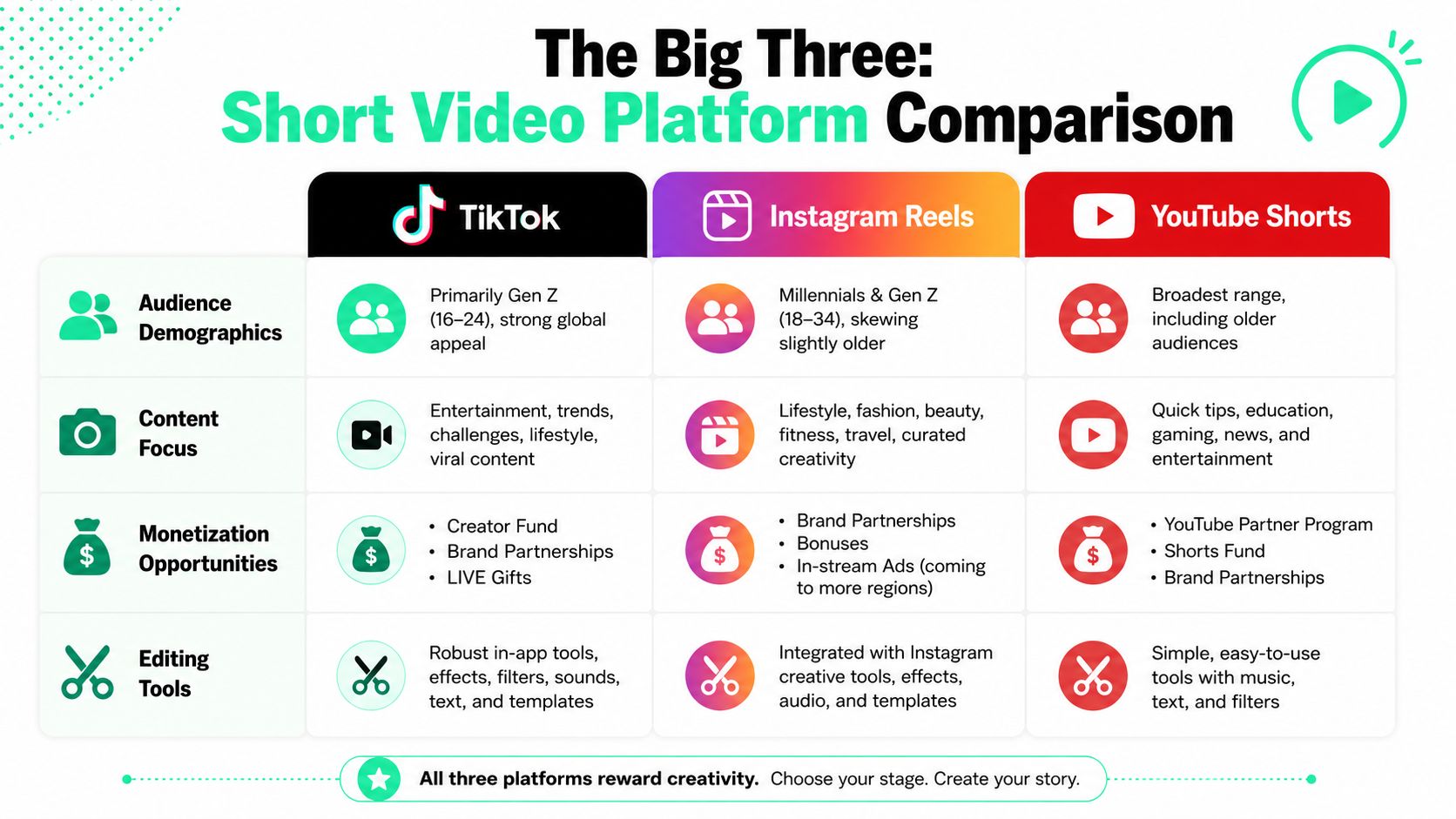
The three biggest short-form environments look similar on the surface. Vertical video. Fast scroll. Algorithmic discovery. But they don't behave the same way, and treating them as identical creates weak results.
### Platform spec comparison
| Feature | TikTok | Instagram Reels | YouTube Shorts |
|---|---|---|---|
| Primary orientation | Vertical | Vertical | Vertical |
| Recommended aspect ratio | 9:16 | 9:16 | **9:16** |
| Technical target | Platform-native vertical export | Platform-native vertical export | **1080×1920 px** |
| Preferred file guidance | Platform-compatible mobile export | Platform-compatible mobile export | **MP4/H.264 video with AAC audio** |
| Feed behavior | Discovery and trend-led viewing | Social graph plus discovery | Search plus feed discovery |
| Length guidance in feed | Varies by use case | Varies by use case | Only the **first 60 seconds** play in the Shorts feed |
For YouTube Shorts specifically, the technical target is **1080×1920 px** in **9:16** format, with **MP4/H.264** video and **AAC** audio recommended for compatibility, and only the first **60 seconds** of a Short play in the feed, as summarized in [vidIQ's YouTube Shorts format guide](https://vidiq.com/blog/post/youtube-shorts-vertical-video/).
A broader tool comparison for creation and editing sits in this guide to [short form video apps](https://www.blitzreels.com/blog/short-form-video-apps).
### TikTok favors native-feeling momentum
TikTok usually rewards content that feels like it belongs in the feed instead of content that looks imported from somewhere else. That doesn't mean low quality. It means low friction. Strong TikToks tend to get to the point quickly, use trends selectively, and avoid visual signals that scream “repurposed ad.”
A brand explainer can work there, but only if it moves like a creator post. Overdesigned intros often hurt more than they help.
A useful platform-level walkthrough is below.
### Instagram Reels rewards polish with restraint
Reels often sits between creator energy and brand presentation. Clean framing, attractive visuals, readable captions, and tidy pacing matter more here than on TikTok. That doesn't mean every Reel should look cinematic. It means messy editing stands out in the wrong way.
Reels is often strong for creators who already have an Instagram audience or want short video tied closely to profile identity. Product demos, aesthetic tutorials, talking-head insights, and behind-the-scenes clips often fit well.
### YouTube Shorts has a search advantage
Shorts can behave more like a fast-answer layer than a pure trend machine. That makes it useful for tutorials, problem-solving clips, and short educational content tied to specific questions. A creator explaining a narrow task can earn attention from people looking for that answer, not just from passive scrollers.
That's the strategic split:
- **Choose TikTok** when culture-fit, trends, and native delivery matter most.
- **Choose Reels** when brand presentation and audience overlap with Instagram matter.
- **Choose Shorts** when searchable utility and fast education are central to the content.
> Treating all three the same usually produces average content on all three.
## The Anatomy of a High-Performing Short
A strong short has three jobs. It must stop the scroll, deliver on the promise, and close with a clear ending. Most underperforming clips fail at the first job. They begin with context, not tension.
Google recommends **10 to 30 second** vertical Shorts for action-oriented ads and reports that using **sound** such as music, voiceover, or both can increase conversions by **over 20%**, according to [Google Ads guidance for YouTube Shorts creative](https://support.google.com/google-ads/answer/16041697?hl=en). The lesson applies beyond ads. Tight runtime and audible creative choices increase the chance that the message lands before attention fades.
### The hook
The hook isn't a greeting. It's a reason to stay. Good hooks make a promise quickly, often through one of three methods:
- **A direct problem:** “Your videos lose viewers before the main point.”
- **A sharp claim:** “Most shorts fail before the edit even starts.”
- **A visual interruption:** sudden movement, unexpected framing, or a bold title card.
For creators working on opening lines, [Framesurfer's guide to hook sentences](https://framesurfer.com/blogs/examples-of-a-hook-sentence) has useful examples across styles and tones. For deeper creative mechanics, this breakdown of [scroll-stopping video hooks](https://www.blitzreels.com/blog/the-science-of-scroll-stopping-video-hooks) is relevant.
### The middle
The middle has one job. Deliver the thing the hook promised.
That sounds simple, but a lot of shorts get lost here. They over-explain, repeat the same sentence in different words, or leave too much dead space between ideas. Fast editing helps, but structure matters more. A viewer should feel movement every few seconds through a new point, a visual cut, a caption emphasis, or a supporting clip.
Useful middle-section tools include:
- **Burned-in captions:** They keep the message legible on mute.
- **Title cards:** They reinforce transitions and reset attention.
- **Clipping and zooms:** They remove hesitation and add momentum.
- **B-roll or screen inserts:** They make explanations easier to process.
### The ending
The ending should resolve the original promise. Sometimes that means a takeaway. Sometimes it means a call to action. Sometimes it means a loop-friendly finish that makes the opening feel connected.
> A short doesn't need a hard sell at the end. It needs closure.
If the hook says “Here's the mistake,” the ending should clearly name the mistake and what to do instead. If the hook offers a tutorial, the viewer should leave with the completed answer. Anything less feels unfinished.
## A Practical Workflow for Creating Shorts Quickly
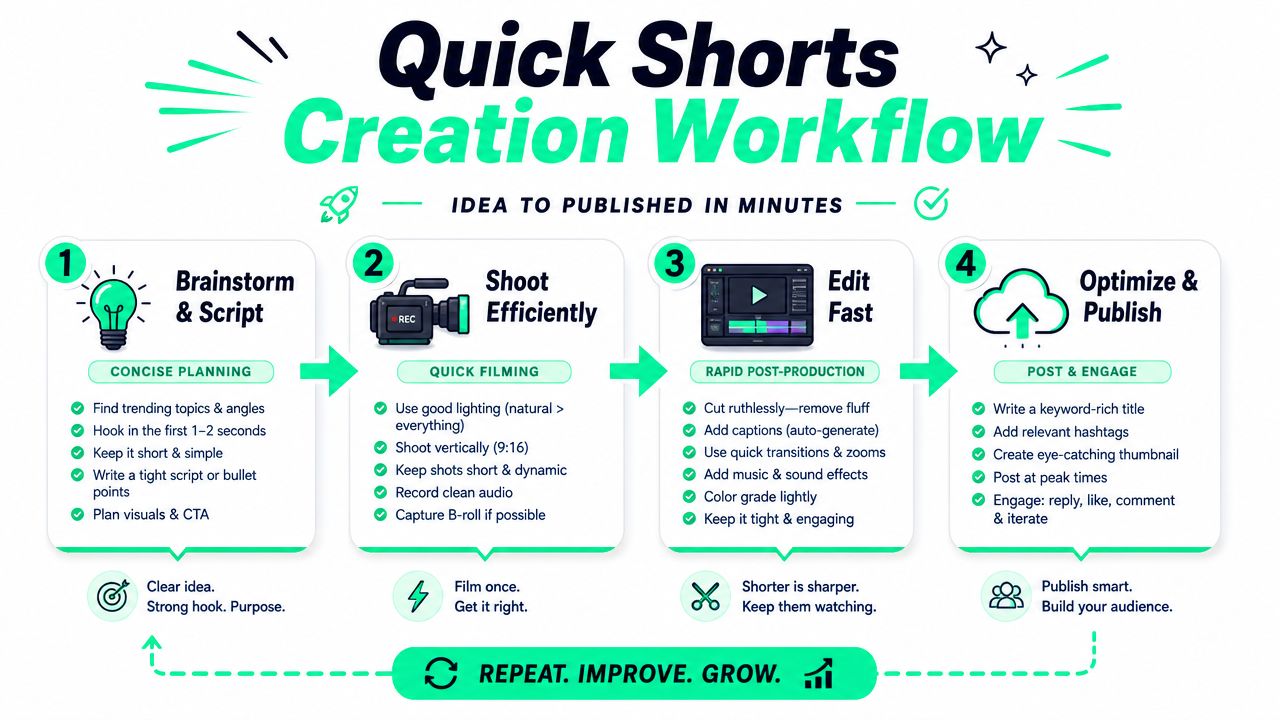
Most creators don't struggle with ideas. They struggle with throughput. The bottleneck usually appears after recording, when one raw clip turns into a pile of manual tasks. Trimming. Captions. Resizing. Reframing. Exporting. Repeating the same process for several platforms.
The better approach is a workflow that assumes short form video will be produced repeatedly, not occasionally. That means designing a system that handles raw footage, clipping, polish, and publishing without rebuilding the process every time.
### Start with clip inventory, not just ideas
A reliable pipeline starts by identifying footage sources. That can include direct-to-camera recordings, webinars, podcasts, Looms, interviews, product demos, tutorials, or livestreams. The key is to think in terms of **clip inventory**. One long recording should produce several usable shorts.
That's why repurposing matters. A strong explanation buried in a longer video often becomes a much stronger short after clipping and reframing. This guide on [turning YouTube videos into TikTok clips](https://www.blitzreels.com/blog/the-30-minute-workflow-for-turning-youtube-videos-into-tiktok-gold) maps that process well.
### Build the edit around retention points
A frequently overlooked question isn't how to make short-form video, but whether every platform should be treated the same. A stronger underserved angle is **platform-specific retention strategy**, as noted in [Iconosquare's discussion of unskippable short-form video](https://www.iconosquare.com/blog/10-tips-to-make-unskippable-short-form-video-with-examples).
That matters in editing. One clip may need different openings, title cards, or pacing depending on where it will run.
A practical production sequence looks like this:
1. **Pull the strongest moment first:** Don't start by trimming from the beginning. Find the clearest payoff or quote, then build around it.
2. **Write an opening title card:** The card should sharpen the promise, not summarize the topic.
3. **Cut silence and hesitation:** Dead air feels longer in short form than it does in long form.
4. **Add captions early:** Caption timing affects pacing, line breaks, and emphasis.
5. **Reframe for vertical:** Keep faces, products, and screen actions centered for mobile viewing.
### Publish as variants, not duplicates
A common mistake is exporting one version and posting it everywhere. That's efficient in the wrong way. It saves minutes and loses relevance.
Different feeds reward different signals. One platform may respond better to a stronger title card. Another may need a cleaner visual style. A tutorial clip might work on Shorts with a more search-friendly framing, while a looser version feels more native on TikTok.
> Short form production gets easier when teams stop thinking in terms of “the final video” and start thinking in terms of reusable variants.
Templates help here. So do saved caption styles, standard intro patterns, and recurring aspect-ratio presets. The less time spent rebuilding formatting decisions, the more time goes into hooks and cuts.
## Measuring What Matters Key Metrics and Performance Analysis
Views can tell whether a video was distributed. They don't say much about whether the edit worked. For short form video, the more useful question is where attention held and where it dropped.
That's why performance review should focus on behavior signals. Watch patterns, completion tendencies, saves, shares, and comments per view reveal more than surface-level reach. A creator trying to improve retention needs to look for friction inside the clip, not just applause after the clip.
### What the metrics actually mean
A practical analytics review usually centers on these signals:
- **Average watch time:** This shows whether the structure kept attention long enough to justify the runtime.
- **Audience retention shape:** Sudden drop-offs often point to a weak hook, a slow transition, or a confusing middle.
- **Shares and saves:** These usually indicate usefulness, surprise, or emotional relevance.
- **Comments per view:** High comment activity can signal strong resonance, disagreement, or a prompt that invited response.
For teams that need more structured access to platform data, the [YouTube Shorts statistics API](https://captapi.com/apis/youtube-shorts-stats) is worth reviewing as a technical reference.
### Match the metric to the content type
A contrarian opportunity is that short video can work as a fast-answer layer for high-intent queries. One niche analysis highlights **60-second Shorts** for specific tasks, implying that concise how-to clips can capture users actively looking for answers, according to [OutlierKit's analysis of untapped YouTube niches](https://outlierkit.com/blog/untapped-youtube-niches).
That changes what success looks like. A trend-based clip may be judged by speed of response and shareability. A search-driven tutorial may matter more for sustained watch quality, problem resolution, and repeat discovery. The wrong metric can push a creator to make the wrong edits.
> If a tutorial keeps the right viewer until the answer lands, it's doing its job even if it doesn't look like an entertainment post.
The practical move is simple. Review top performers in clusters. Compare hooks against hooks. Compare tutorials against tutorials. Compare talking-head advice against similar clips. That reveals what the audience rewards instead of mixing unrelated formats together.
## The Right Tools for a Faster Workflow
Tool choice matters because short form video has too many repetitive steps to manage manually forever. A creator can edit one clip by hand. The problem starts when that creator needs a weekly output across TikTok, Reels, Shorts, LinkedIn, and other placements.
Three categories usually matter most.
### All-in-one editors
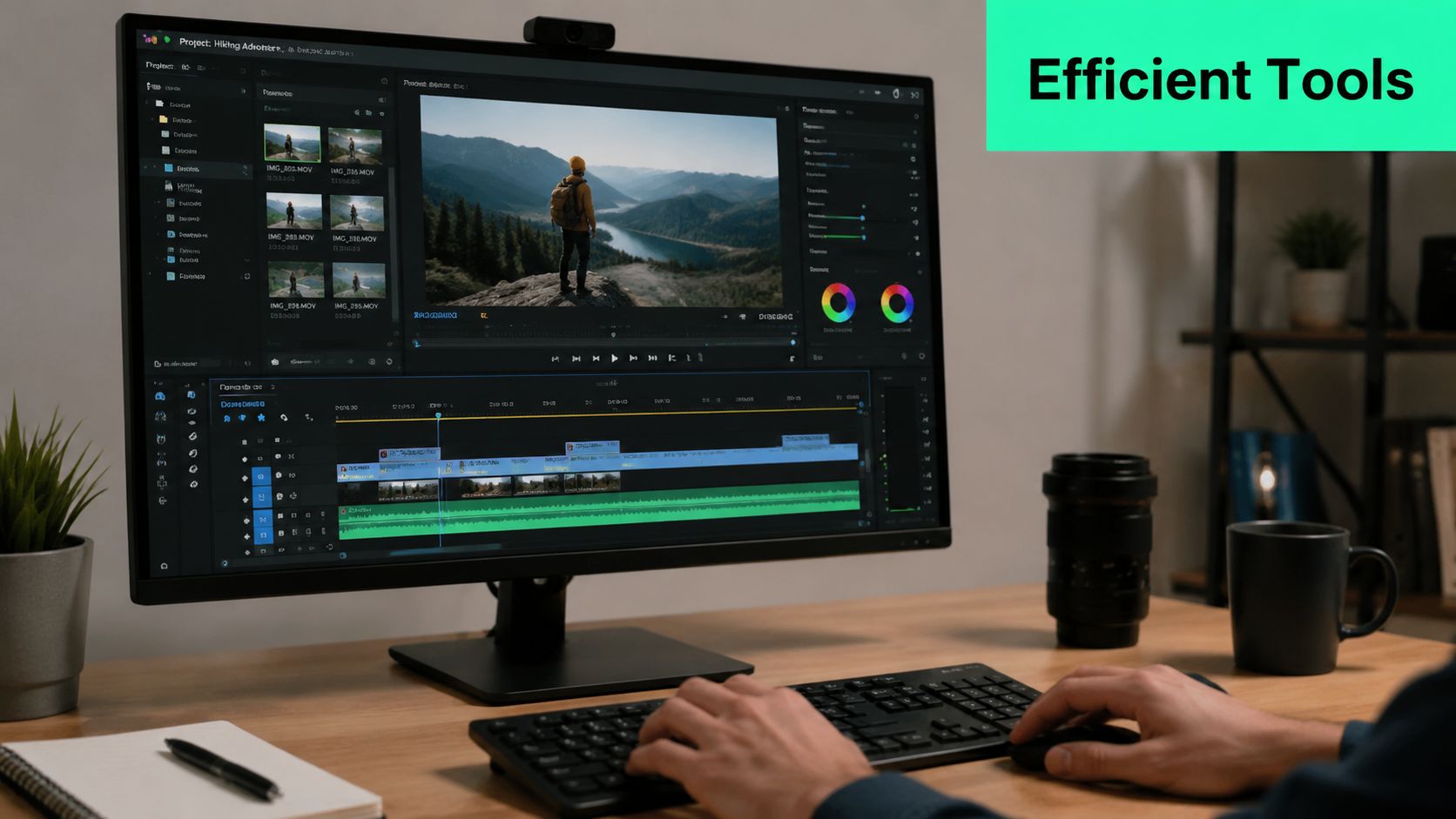
These tools handle clipping, timeline edits, captions, title cards, reframing, and export in one place. They're useful when speed matters more than deep manual control. For many teams, this is the right trade-off because the bottleneck isn't creative vision. It's getting polished videos out the door consistently.
### Caption and subtitle tools
Some workflows only need transcript cleanup, subtitle styling, and SRT handling. These tools fit teams that already edit elsewhere but still need readable captions and quick subtitle revisions.
### Repurposing tools
Repurposing software matters when the content source starts long. A webinar, podcast, interview, or screen recording rarely becomes short-form-ready without smart clipping and vertical adaptation. That's where tools that identify usable moments, crop for mobile, and standardize outputs save the most time.
A practical reference for broader category selection is this guide to a [video editor for social media](https://www.blitzreels.com/blog/video-editor-for-social-media).
One tool in this category is [BlitzReels](https://blitzreels.com), which is built for short-form workflows such as clipping source footage, generating captions, reframing to vertical, resizing for platform outputs, adding title cards and templates, and repurposing longer videos into social-ready cuts. That kind of setup is useful when the main problem isn't whether editing is possible, but whether publishing can happen fast enough to stay consistent.
The right stack depends on the constraint. If a team already has editors, subtitle software may be enough. If the team is drowning in raw footage and missed posting windows, an all-in-one repurposing workflow usually makes more sense.
---
BlitzReels fits the operational side of short form video creation. It helps turn raw clips, webinars, podcasts, tutorials, and recordings into captioned, reframed, platform-ready videos without rebuilding the edit from scratch each time. For creators and teams trying to publish more consistently, it's a practical way to reduce clipping, resizing, and formatting bottlenecks while keeping output optimized for TikTok, Instagram Reels, YouTube Shorts, LinkedIn, and similar feeds.