---
title: "Video Hook Generator: How AI Writes Scroll-Stopping Openings"
canonical: "https://blitzreels.com/blog/video-hook-generator"
---
# Video Hook Generator: How AI Writes Scroll-Stopping Openings
URL: https://blitzreels.com/blog/video-hook-generator
Markdown URL: https://blitzreels.com/blog/video-hook-generator.md
Published: 2026-08-30
Author: BlitzReels
Learn how a video hook generator works, the AI behind it, platform-specific hook templates, prompt examples, and how to test and optimize opening seconds
Tags: video hook generator, AI hook generator, short-form hooks, TikTok hook, BlitzReels

A 2025 analysis of **46,605 TikTok hooks** across more than **20 content categories** found that emotional openings appeared in only about **3.2% of posts**, yet generated proportionally more comments and shares than more common formats. The same analysis identified five stable hook archetypes and found that effective length varied sharply by niche, from about **9 words in news to about 90 words in entertainment**. The lesson is uncomfortable for those looking for a “viral” sentence: a strong hook isn't short. It matches the category, framing, audience, visual opening, and retention goal. [Read the empirical analysis of TikTok hooks](https://www.rjwave.org/jaafr/papers/JAAFR2604815.pdf).
A **video hook generator** becomes useful when it stops acting like a copywriting toy. Its job is to produce controlled opening options, connect each option to an editing choice, and help creators test what keeps viewers watching. The best workflow treats the hook as a measurable retention checkpoint, not as a clever line that gets approved by instinct.
## Table of Contents
- [Why the First Second Decides Everything](#why-the-first-second-decides-everything)
- [The retention cliff in practice](#the-retention-cliff-in-practice)
- [What a Video Hook Generator Actually Does](#what-a-video-hook-generator-actually-does)
- [What comes back from the prompt](#what-comes-back-from-the-prompt)
- [The AI Approaches Behind Modern Hook Generators](#the-ai-approaches-behind-modern-hook-generators)
- [Template-driven generation](#template-driven-generation)
- [Transcript-conditioned generation](#transcript-conditioned-generation)
- [Retrieval-augmented generation](#retrieval-augmented-generation)
- [Platform-Specific Hook Templates That Convert](#platform-specific-hook-templates-that-convert)
- [TikTok](#tiktok)
- [Instagram Reels](#instagram-reels)
- [YouTube Shorts and LinkedIn](#youtube-shorts-and-linkedin)
- [Prompt Examples and Inputs That Produce Reliable Hooks](#prompt-examples-and-inputs-that-produce-reliable-hooks)
- [B2B founder on LinkedIn](#b2b-founder-on-linkedin)
- [Fitness creator on TikTok](#fitness-creator-on-tiktok)
- [Recipe channel on Reels](#recipe-channel-on-reels)
- [SaaS explainer on Shorts](#saas-explainer-on-shorts)
- [Fitting Hook Generation Into a Short-Form Editing Workflow](#fitting-hook-generation-into-a-short-form-editing-workflow)
- [Testing and Optimizing Hooks Against Real Retention Data](#testing-and-optimizing-hooks-against-real-retention-data)
- [A clean iteration loop](#a-clean-iteration-loop)
- [Putting It All Together and Avoiding Common Pitfalls](#putting-it-all-together-and-avoiding-common-pitfalls)
## Why the First Second Decides Everything
A common short-form planning assumption says that **80% of viewers decide whether to keep watching within the first one to three seconds**. That exact figure isn't included in the verified research available for this article, so it shouldn't be presented as fact. The verified evidence still makes the practical point clearly: the opening seconds act as a severe filter, and creators can see the result in a retention graph that drops before the main idea has started. [Independent short-form guidance recommends comparing three-second retention curves](https://www.perceedigital.com/insights/video-hooks-that-convert/).
A creator may spend hours finding the right clip, styling captions, adding B-roll, and tightening pauses. After publishing, the graph can still fall immediately because the speaker begins with a greeting, a logo, or context the viewer hasn't agreed to receive. The creator sees a flat line after the opening, then wonders why the later explanation, proof, or CTA never had a chance.
### The retention cliff in practice
The viewer's sequence is fast:
1. **The thumb pauses** because movement, contrast, or an unexpected composition interrupts the feed.
2. **The eye registers the frame**, often through a face, object, caption, or visible action.
3. **The brain looks for a payoff**, such as an answer, demonstration, transformation, conflict, or useful warning.
4. **The viewer either stays or swipes**, usually before the edit's strongest material appears.
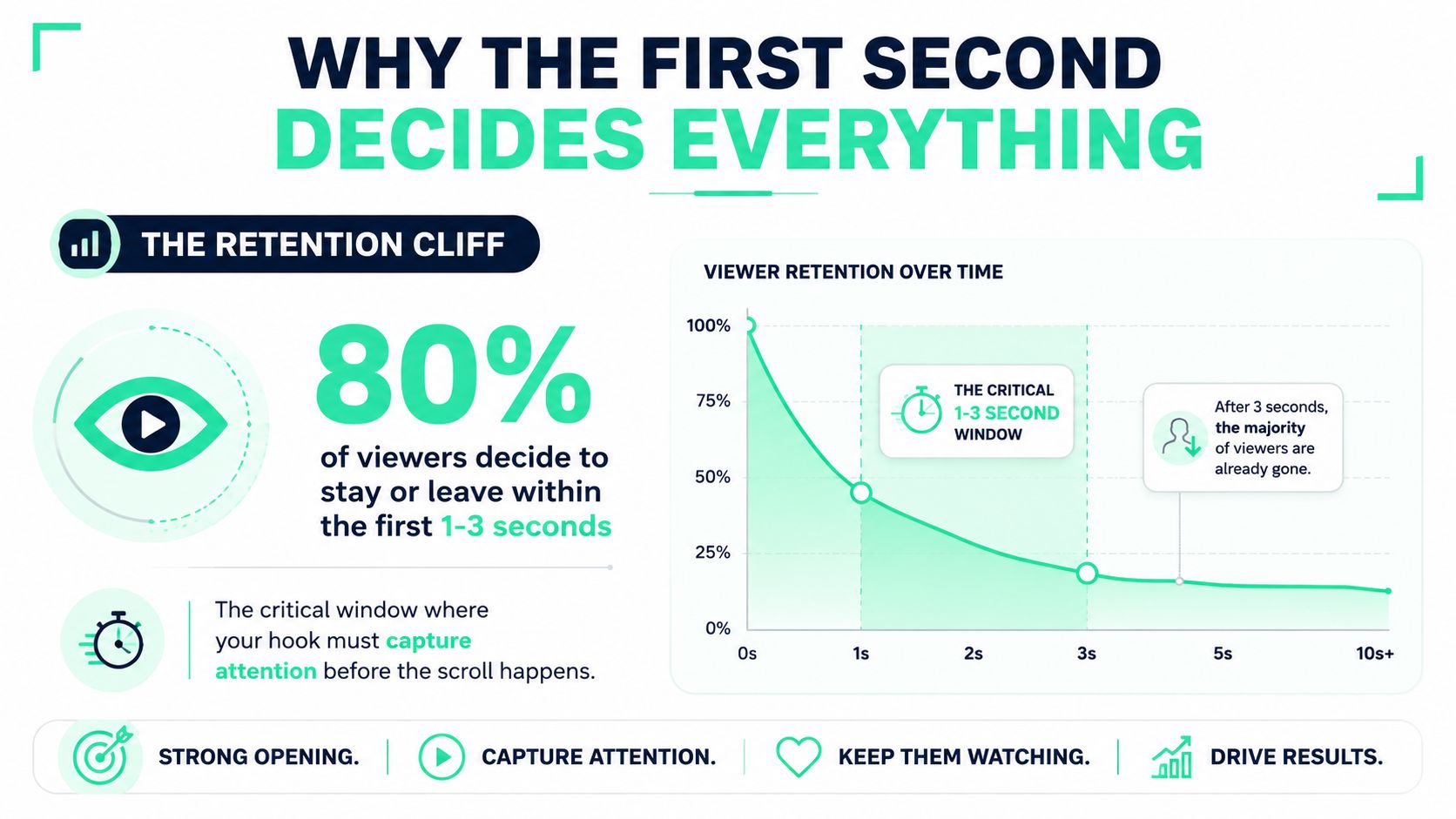
A hook therefore has three jobs, not one. It must interrupt attention, identify relevance, and make a credible promise that the next beat will fulfill. The opening line can be excellent and still fail if the first frame shows unrelated footage. A striking visual can also fail if the spoken line explains nothing.
> **Practical rule:** The hook is the first promise, while captions, B-roll, pacing, and the rest of the edit are the delivery system.
The [SupaBird hook writing playbook](https://supabird.io/articles/how-to-write-hooks) can help creators compare common opening structures, but templates shouldn't replace judgment. A question works when the audience wants the answer. A contrarian claim works when the speaker can support it. A curiosity gap works when the payoff arrives soon enough to feel earned.
That is why the **[short-form video glossary](https://blitzreels.com/glossary/short-form-video)** matters for newer creators. Short-form isn't just long-form video compressed into a smaller frame. Its opening, visual hierarchy, captions, and pacing have to communicate before the viewer has invested attention.
## What a Video Hook Generator Actually Does
A **video hook generator** is a prompt layer that creates possible opening lines, on-screen text, or visual cues for a short-form clip. The creator supplies the raw material and constraints. The tool returns several ways to begin, usually shaped around a topic, transcript, audience, platform, tone, and promised outcome.
A useful input isn't “write a viral hook about marketing.” It gives the generator something it can reason about:
- **Topic or transcript:** What the clip discusses.
- **Audience:** Beginners, practitioners, buyers, founders, or another defined group.
- **Platform:** TikTok, Instagram Reels, YouTube Shorts, or LinkedIn.
- **Tone:** Direct, playful, analytical, urgent, or understated.
- **Payoff:** The lesson, demonstration, reveal, or decision the viewer receives.
- **Constraints:** Words to avoid, claims that need proof, and the desired delivery style.
### What comes back from the prompt
A practical output might contain **three to seven variants**, an on-screen text option for each, and a visual suggestion such as opening on the finished dish, cutting to the result first, or displaying the transcript's strongest claim. The generator isn't deciding which option is true. It's assembling candidates from the material provided.
At the prompt layer, the process usually looks like this:
1. **Scan the topic or transcript** for tension, contrast, a mistake, a result, or an unanswered question.
2. **Map that material to a hook family**, such as a direct promise, myth correction, proof-first opener, or story cold open.
3. **Rewrite the idea within voice constraints**, removing language that sounds unlike the creator.
4. **Pair the line with a first-frame suggestion**, so the words and edit support the same promise.
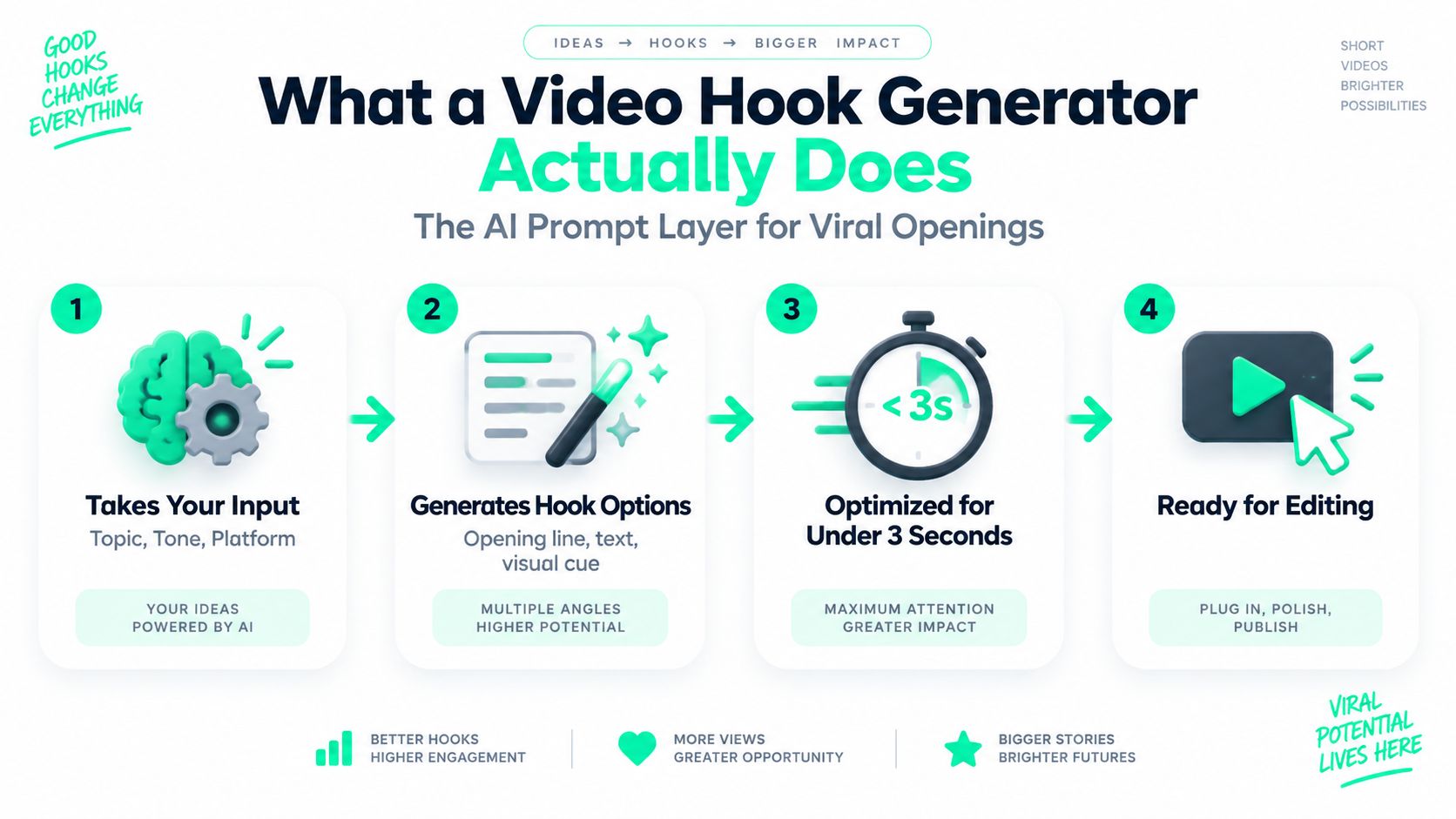
The important distinction is between **generation and validation**. A generator can create a clear opening, but it can't know whether the footage supports the claim, whether the creator can say it naturally, or whether the audience will stay. Human review remains necessary before recording or editing.
A creator evaluating [BlitzReels AI models](https://blitzreels.com/docs/ai-models) should ask whether the tool can work from actual video material rather than only a typed topic. Transcript access, clip context, captions, and timeline awareness produce more usable options than isolated copy.
## The AI Approaches Behind Modern Hook Generators
Modern hook tools generally use one or more practical approaches. Each approach makes a different compromise between **control, originality, and niche relevance**. The right choice depends less on model novelty and more on how the creator produces content.
| Approach | How It Works | Best For | Main Trade-off |
|---|---|---|---|
| Template-driven generation | Fills a known structure with the creator's topic, audience, and payoff | Fast ideation and clean A/B tests | Predictable output can sound familiar |
| Transcript-conditioned generation | Finds a strong claim or tension point inside existing footage and rewrites it as an opener | Podcasts, webinars, interviews, and YouTube repurposing | Weak or vague source material limits the result |
| Retrieval-augmented generation | Uses a niche-specific library of reference hooks to guide wording and framing | Topic fit and specialized language | Similar examples can pull the output toward imitation |
### Template-driven generation
Templates provide the strongest control. A creator can request question hooks, contrarian openings, direct problem statements, or proof-first lines and compare like with like. The method is easy to document because each output has a recognizable structure.
Its weakness is sameness. If every fitness creator receives “Stop doing this if you want results,” the wording may remain clear but lose distinctiveness. Templates work best as a first pass, followed by a rewrite grounded in a real example or visible action.
### Transcript-conditioned generation
Transcript conditioning is more useful when the source already contains substance. A long interview may include a buried admission, a surprising answer, or a specific explanation that can become the first beat. The tool extracts that moment instead of forcing the editor to invent a claim unrelated to the footage.
This approach can't rescue a recording that has no clear point. It also requires the editor to check that the shortened opening preserves meaning and doesn't remove a qualification that made the original statement accurate.
### Retrieval-augmented generation
Retrieval adds niche context by comparing the request with a collection of relevant examples. That can help a SaaS founder sound familiar to a technical audience or help a recipe creator use a recognizable food-video rhythm. It also creates a risk of copying the surface pattern of existing content.
Creators exploring [product marketing demo tools](https://www.rendemo.com/blog/which-ai-tools-can-create-a-polished-interactive-product-demo-from-an) can apply the same decision logic to demonstration videos. The strongest system isn't necessarily the one with the most elaborate generation layer. It's the one that exposes enough control to preserve the source, brand voice, and intended audience.
## Platform-Specific Hook Templates That Convert
A hook should fit the platform's viewing context and the creator's measurable goal. Research comparing hook formats found that combining visual, verbal, and textual elements outperformed visual hooks alone across watch time, engagement, and completion. [See the study and its reported comparison](https://shortzly.com/blog/viral-hook-formulas-stop-the-scroll).
The result is a production brief, not just a sentence. A video hook generator should specify the spoken line, first frame, on-screen text, and metric to test. Treat each output like a labeled experiment: change one element, then compare early hold, completion, watch time, saves, sends, or qualified engagement.
| Platform | Hook Template Pattern | Example Opening Line | Primary Retention Metric |
|---|---|---|---|
| TikTok | Pattern interrupt, fast tension, immediate proof | “This editing mistake is hiding the best part of the clip.” | Early hold and completion |
| Instagram Reels | Aspirational result, attractive visual, quick explanation | “The finished dish appears first, then the shortcut that makes it possible.” | Watch time, saves, and sends |
| YouTube Shorts | Direct problem, clear promise, rapid demonstration | “Why do captions cover the subject in vertical video?” | Completion and average view duration |
| LinkedIn | Credibility cue, specific problem, useful insight | “After reviewing short-form workflows, one bottleneck appears repeatedly.” | Qualified watch time and engagement |
### TikTok
TikTok rewards an action or sharp claim before a formal introduction can slow the opening. A fitness creator could start with the modified movement already underway and say, “This version makes the exercise accessible without removing the challenge.” A second template places the tension beside visible proof: “The mistake isn't the exercise. It's the setup.”
Generate several versions, then keep the first frame constant while testing the wording. Early hold shows whether the claim earns the first pause; completion shows whether the promised demonstration arrives quickly enough. Creators can use [TikTok hook templates for starting structures](https://blitzreels.com/templates/tiktok), then adapt the language to their footage.
### Instagram Reels
Reels often suits a polished visual payoff for food, design, fashion, travel, and product content. A recipe channel can show the finished plate, overlay “The texture comes from this overlooked step,” and cut directly to preparation. The visual earns the pause, while the explanation gives viewers a reason to save or send the post.
### YouTube Shorts and LinkedIn
Shorts usually benefits from a direct problem followed by a rapid visual answer. The generator should pair each claim with the demonstration that proves it, then judge the version by completion and average view duration.
LinkedIn requires a different credibility signal. A casual “You won't believe this” opener can conflict with an audience seeking professional context. Use a concrete business problem, experience cue, or useful observation early, and compare versions by qualified watch time and engagement. The same template can guide both platforms, but the evidence and delivery must match the viewer's reason for watching.
## Prompt Examples and Inputs That Produce Reliable Hooks
A structured prompt gives the generator boundaries. Vague requests invite generic language because the tool has no reason to prefer one audience, promise, or delivery style over another.
### B2B founder on LinkedIn
**Inputs**
- Topic: Why onboarding projects stall
- Audience: Operations leaders at growing companies
- Platform: LinkedIn
- Desired emotion: Recognition and confidence
- Forbidden phrases: “game changer,” “you won't believe”
- Length cap: One spoken sentence
**Output**
> “Most onboarding delays begin before the customer ever meets the implementation team.”
The opening works because it challenges a familiar assumption without making an unsupported result claim. The next sentence should explain the overlooked planning step.
### Fitness creator on TikTok
**Inputs**
- Topic: A lower-impact squat variation
- Audience: Beginners with knee discomfort
- Platform: TikTok
- Desired emotion: Relief and curiosity
- Forbidden phrases: “no pain, no gain,” “secret”
- Length cap: Under three seconds of speech
**Output**
“Try this squat variation before giving up on squats.”
The first frame should show the movement, not a talking-head introduction. The wording creates a reason to watch while keeping the promise modest.
### Recipe channel on Reels
**Inputs**
- Topic: Crisp roasted potatoes
- Audience: Home cooks
- Platform: Instagram Reels
- Desired emotion: Appetite and curiosity
- Forbidden phrases: “viral,” “ultimate,” “life-changing”
- Length cap: One short line
**Output**
“The crispest part starts before the potatoes reach the oven.”
The editor can show the finished texture first, then reveal the preparation step.
### SaaS explainer on Shorts
**Inputs**
- Topic: Automating transcript-based clipping
- Audience: Small marketing teams
- Platform: YouTube Shorts
- Desired emotion: Clarity
- Forbidden phrases: “effortless,” “magic,” “instant”
- Length cap: Under three seconds of speech
**Output**
“Long videos already contain the clips. The bottleneck is finding them.”
This line states a problem and points toward the demonstration that follows.
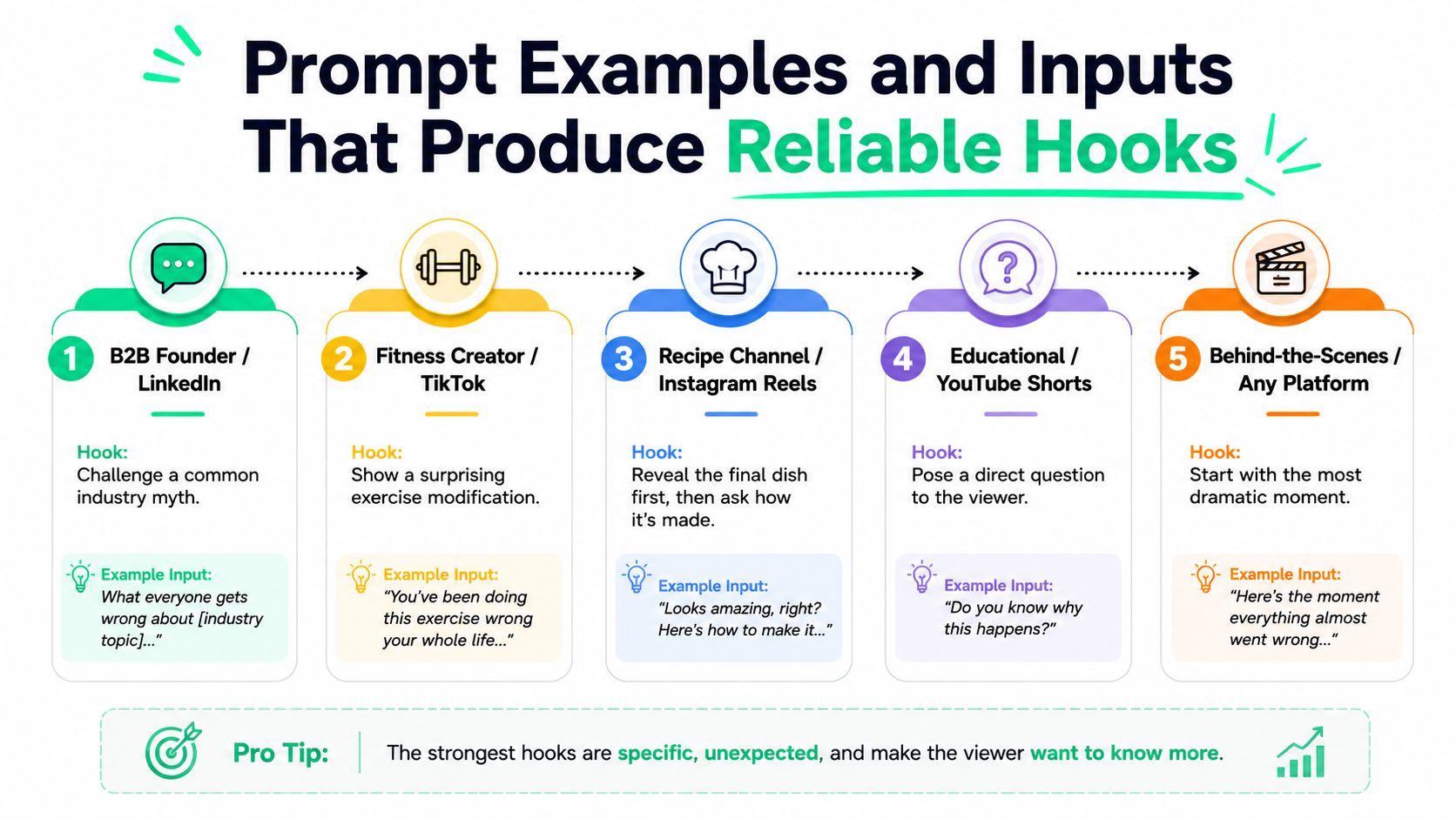
A behind-the-scenes prompt can use the same schema: **topic**, **audience**, **platform**, **emotion**, **banned language**, **length**, and **visual opening**. A creator who wants to [improve AI brand visibility with prompts](https://www.mymentions.org/blog/how-to-create-effective-ai-prompts) should treat those fields as brand controls, not administrative details. They tell the generator what the brand sounds like and what it refuses to promise.
Negative constraints improve output because they remove easy but weak answers. Banning exaggerated claims, recycled openings, or unsupported outcomes forces the model toward language the creator can defend. The final review should ask whether the first frame, spoken line, text overlay, and next beat all point to the same payoff. More adaptable prompt patterns are available in the [BlitzReels AI video prompts guide](https://blitzreels.com/guide/25-ai-video-prompts).
## Fitting Hook Generation Into a Short-Form Editing Workflow
Hook generation works best inside the production loop, close to the timeline. A separate browser tab can produce attractive wording, but the editor still has to locate the matching footage, rebuild the opening, create captions, reframe the shot, and export the result. That distance encourages creators to choose the line that sounds best instead of the line the footage can support.
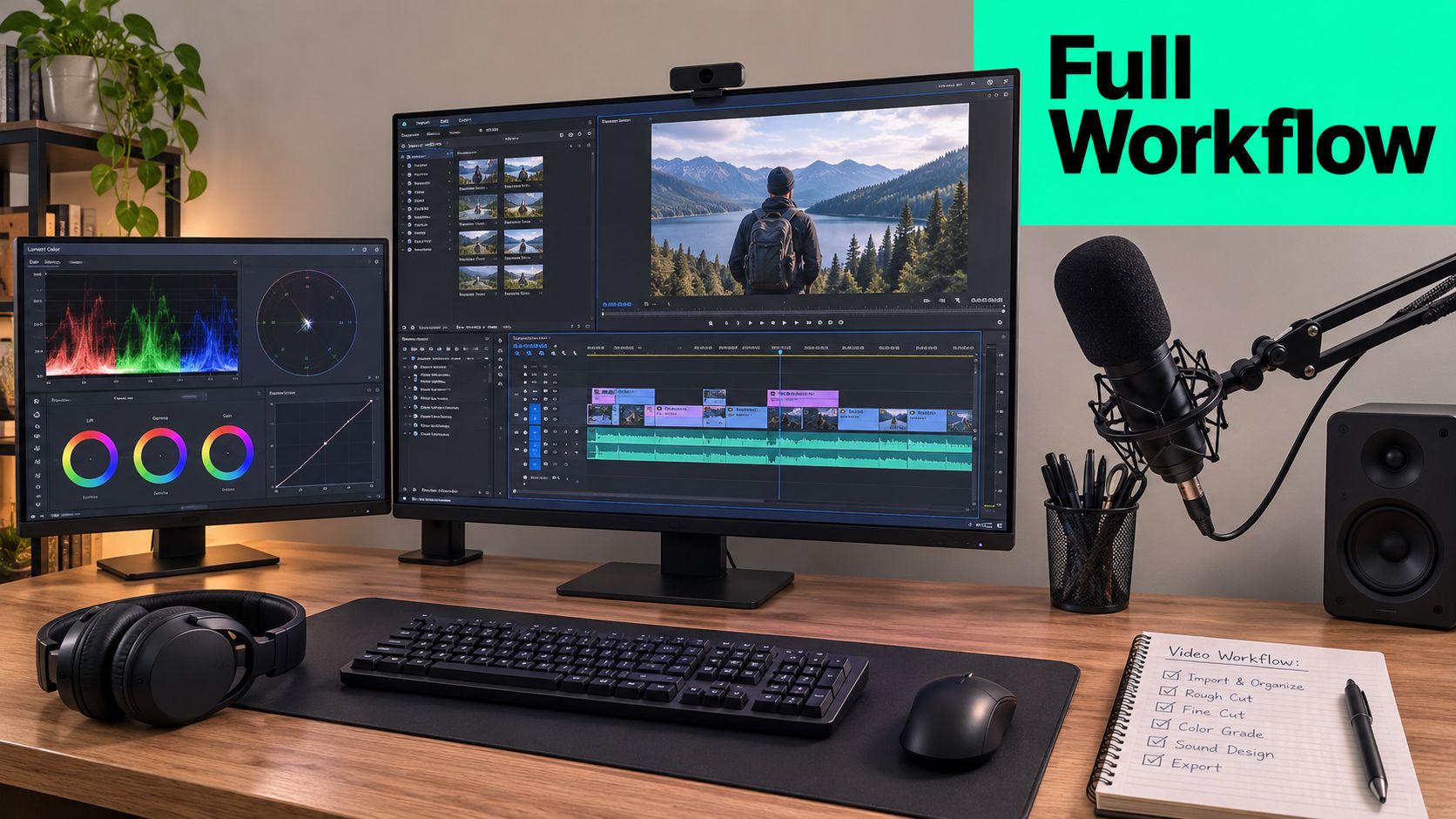
A workable chain looks like this:
1. **Start with the source.** Import a podcast, webinar, interview, call, or YouTube video.
2. **Find candidate moments.** Search the transcript for claims, tension, mistakes, answers, or visible demonstrations.
3. **Generate variants.** Ask for platform-specific spoken lines, on-screen text, and opening-frame suggestions.
4. **Choose against the footage.** Reject any hook that overstates the source or requires a visual that doesn't exist.
5. **Edit the opening.** Move the strongest frame forward, remove the greeting, tighten the first cut, and place the spoken hook immediately.
6. **Add captions and B-roll.** Keep text readable and use supporting media only when it clarifies the promise.
7. **Reframe and resize.** Prepare the vertical composition, check the subject's position, and review safe areas.
8. **Export and inspect.** Verify captions, audio, crop, title cards, and render status before publishing.
BlitzReels fits this workflow as an **agentic AI video editor** with a native hosted OAuth MCP server and REST API. Through its supported tools, agents such as Claude, Codex, or Cursor can inspect projects, find clips, edit transcripts and captions, add B-roll or media, modify timeline items, validate output, start exports, and check render status. The same workflows are exposed through a TypeScript SDK, CLI with structured JSON, OpenAPI, `llms.txt`, and agent skills, while human editors retain browser-based review and final control.
For teams comparing automation architectures, a hosted cloud editor differs from a local MCP editor, a professional-NLE integration, or an FFmpeg server. BlitzReels uses **Streamable HTTP** for its hosted MCP transport, with a single HTTP endpoint for JSON-RPC over POST and optional Server-Sent Events for streaming. Its remote authentication guidance uses OAuth 2.1, with PKCE required for clients in the cited protocol revision and resource metadata used to bind tokens to the intended MCP server. [Review the Streamable HTTP specification summary](https://blitzcutai.com/blog/best-caption-size-youtube-shorts-2026) and [the remote MCP OAuth guidance](https://mcp.directory/blog/oauth-21-for-remote-mcp-servers-streamable-http-explained-2026).
An ideal setup lets the creator inspect the actual opening, compare hook variants, style captions, add a title card or B-roll, resize the frame, and review the export without rebuilding the project in multiple applications.
## Testing and Optimizing Hooks Against Real Retention Data
A hook that sounds clever in a review meeting may still lose viewers. Validation requires a defined metric, consistent publishing conditions, and enough observations to avoid treating one unusual post as a permanent lesson.
Independent creator guidance recommends testing **three to five hook variants** and comparing three-second retention curves. [Percee Digital outlines that testing approach](https://www.perceedigital.com/insights/video-hooks-that-convert/). A practical test can use one primary measure, such as three-second hold rate, average view duration, or hook-specific drop-off. The creator should choose one before publishing so the decision doesn't shift after results appear.
The requested testing range of **five to ten posts per variant** isn't supported by the verified data, so it shouldn't be stated as a required sample size. Instead, each creator should use a repeatable batch large enough to reduce the influence of posting time, topic differences, distribution changes, and unusually strong or weak footage.
| Variable Tested | Primary Metric | Sample Size | Decision Threshold |
|---|---|---|---|
| Spoken opening line | Three-second retention curve | Consistent batch chosen by the creator | Keep the variant that holds attention more reliably |
| On-screen text | Early drop-off | Same source idea where possible | Keep the clearer text treatment |
| First-frame visual | Early hold and average view duration | Comparable edits | Keep the visual that supports the promise |
| Opening pace | Completion rate | Similar duration and topic | Keep the cadence that sustains viewing |
| Hook angle | Saves, shares, or qualified engagement | Platform-appropriate batch | Keep the angle that matches the distribution goal |
### A clean iteration loop
The creator should change one variable at a time. If the spoken line, first frame, caption style, and music all change together, the analytics can't identify the cause. A simple spreadsheet can record the platform, topic, hook family, opening text, first visual, publication context, chosen metric, and result.
[Video analytics](https://blitzreels.com/glossary/video-analytics) should be read as evidence, not as a verdict on the entire video. A sharp early drop points toward an opening problem, but a later decline may indicate pacing, unclear structure, or a weak payoff. The editor should also verify that the hook promised what the body delivered. A high initial hold followed by a fast decline can indicate an attractive but misleading opener.
> **Testing principle:** Generate several angles, but let retention and completion decide which wording earns another edit.
Winning patterns should return to the prompt. If direct problem statements hold attention better than broad curiosity gaps for a particular audience, future prompts can prioritize direct diagnosis. If visual-first openings perform better than spoken introductions, the generator should return a first-frame action alongside every line.
## Putting It All Together and Avoiding Common Pitfalls
A disciplined workflow can stay simple:
1. Choose **two platform targets** for the video.
2. Generate **five hook variants** with platform, audience, payoff, and banned-language fields.
3. Select the variants that the existing footage can prove.
4. Edit the first frame, spoken line, captions, and next beat as one unit.
5. Test against a defined retention metric during a consistent publishing window.
6. Refine the prompt using the patterns that perform better.
The most common mistake is relying on a generic curiosity gap without a concrete payoff. Other failures include ignoring native audio and visual conventions, generating copy without checking the actual opening frame, and accepting AI wording that doesn't sound like the creator. A hook can be technically clear and still weaken trust if the speaker would never use the phrase aloud.
Platform mechanics also matter during production. TikTok, Instagram Reels, and YouTube Shorts commonly use **1080×1920 pixels in a 9:16 frame**, while a published guide recommends keeping important content inside a central safe area of about **900×1400 pixels** so captions and interface controls don't obscure it. [Review the cross-platform sizing guidance](https://anfx.co/blog/youtube-shorts-tiktok-reels-video-size-guide/). Another guide lists TikTok in-feed ads at a common **21 to 34 seconds**, Instagram Reels ads up to **90 seconds**, organic Reels up to **3 minutes**, and YouTube Shorts ads up to **60 seconds**, so one source clip may need different cuts rather than a simple resize. See the cited social-video specifications.
A video hook generator is one controlled step in a repeatable system. It creates options, the editor checks truth and voice, the timeline makes the promise visible, and retention data determines what earns another test.
---
BlitzReels combines AI clipping, hook development, transcript and caption editing, B-roll, title cards, vertical reframing, resizing, templates, human review, and cloud exports in one video workflow. Visit [BlitzReels](https://blitzreels.com) to turn hook variants from isolated copy into reviewed, publish-ready short-form edits.