---
title: "View Through Rate Explained and How Creators Can Lift It"
canonical: "https://blitzreels.com/blog/view-through-rate"
---
# View Through Rate Explained and How Creators Can Lift It
URL: https://blitzreels.com/blog/view-through-rate
Markdown URL: https://blitzreels.com/blog/view-through-rate.md
Published: 2026-08-18
Author: BlitzReels
Learn what view through rate really means, how platforms count it differently, and the editing moves that raise it on TikTok, Reels, and YouTube Shorts.
Tags: view through rate, short-form video, video completion rate, TikTok benchmarks, BlitzReels

A TikTok video under **10 seconds** can reach an **81.2% completion rate**, while videos longer than **90 seconds** fall to **22.7%**, according to [TikTok completion-rate data](https://insights.ttsvibes.com/tiktok-video-completion-rate-statistics/). That gap reframes view through rate. The metric isn't only a report-card number after publishing. It reflects whether the opening, pacing, captions, and payoff gave viewers a reason to keep watching.
A creator can upload two nearly identical clips, use the same topic, and receive similar likes, yet see one travel much farther. Often, the difference sits in the first few seconds. One version reaches the point immediately, while the other spends too long setting it up.
## Table of Contents
- [Why View Through Rate Matters for Short-Form Creators](#why-view-through-rate-matters-for-short-form-creators)
- [Defining View Through Rate and the Standard Formula](#defining-view-through-rate-and-the-standard-formula)
- [VTR and view-through conversions are different](#vtr-and-view-through-conversions-are-different)
- [Why dashboards don't line up](#why-dashboards-dont-line-up)
- [How YouTube, TikTok, Instagram, LinkedIn, and CTV Count Views Differently](#how-youtube-tiktok-instagram-linkedin-and-ctv-count-views-differently)
- [A normalization checklist](#a-normalization-checklist)
- [Benchmarks for Short-Form Platforms in 2026](#benchmarks-for-short-form-platforms-in-2026)
- [Runtime changes the editing problem](#runtime-changes-the-editing-problem)
- [When a High VTR Is Misleading and What to Measure Instead](#when-a-high-vtr-is-misleading-and-what-to-measure-instead)
- [The three signals](#the-three-signals)
- [Editing Moves That Lift Short-Form VTR](#editing-moves-that-lift-short-form-vtr)
- [Start with a specific promise](#start-with-a-specific-promise)
- [Cut for momentum](#cut-for-momentum)
- [Fit the frame to the feed](#fit-the-frame-to-the-feed)
- [A Weekly Measurement Routine for Testing and Improving VTR](#a-weekly-measurement-routine-for-testing-and-improving-vtr)
## Why View Through Rate Matters for Short-Form Creators
Short-form distribution starts with an impression. The platform shows the video, then measures whether that exposure becomes a counted view and whether viewers continue watching. **View through rate, or VTR, captures the first part of that chain**, which makes it an important upstream signal for creators publishing on [short-form video platforms](https://blitzreels.com/glossary/short-form-video).
A weak opening can lose a viewer before the subject becomes clear. A sharper opening can create enough initial attention for the rest of the edit to matter. That's why a title card, a spoken promise, a visible result, or a fast visual change can influence performance more than a polished ending.
> **Practical rule:** A creator shouldn't diagnose the whole video before checking whether the first moments earned continued attention.
VTR also helps separate a distribution problem from a content problem. If a clip receives impressions but few counted views, the hook, first frame, caption readability, or subject relevance may be failing. If viewers start but leave quickly, the opening may work while the pacing or payoff doesn't. If viewers finish but take no meaningful action, the video may be entertaining without creating intent.
That distinction matters across TikTok, Instagram Reels, YouTube Shorts, LinkedIn, and connected television. Each surface can use a different threshold for a qualifying view, so a number copied from one dashboard doesn't automatically describe performance on another. Creators comparing campaigns should first identify the placement, denominator, view threshold, and video length.
VTR also sits beside a separate measurement problem, delayed action after exposure. Marketers evaluating non-clicked exposure can use resources on [measuring delayed ad impact](https://adwave.com/resources/view-thru-rate) to distinguish attention from later response. The same discipline applies to organic short-form content: completion tells creators that viewers stayed, but it doesn't prove that viewers understood, remembered, or acted.
The useful workflow is straightforward. Define the metric, inspect each platform's counting rule, compare benchmarks by runtime, connect VTR with retention and conversion signals, then edit the opening and pacing instead of chasing a universal target.
## Defining View Through Rate and the Standard Formula
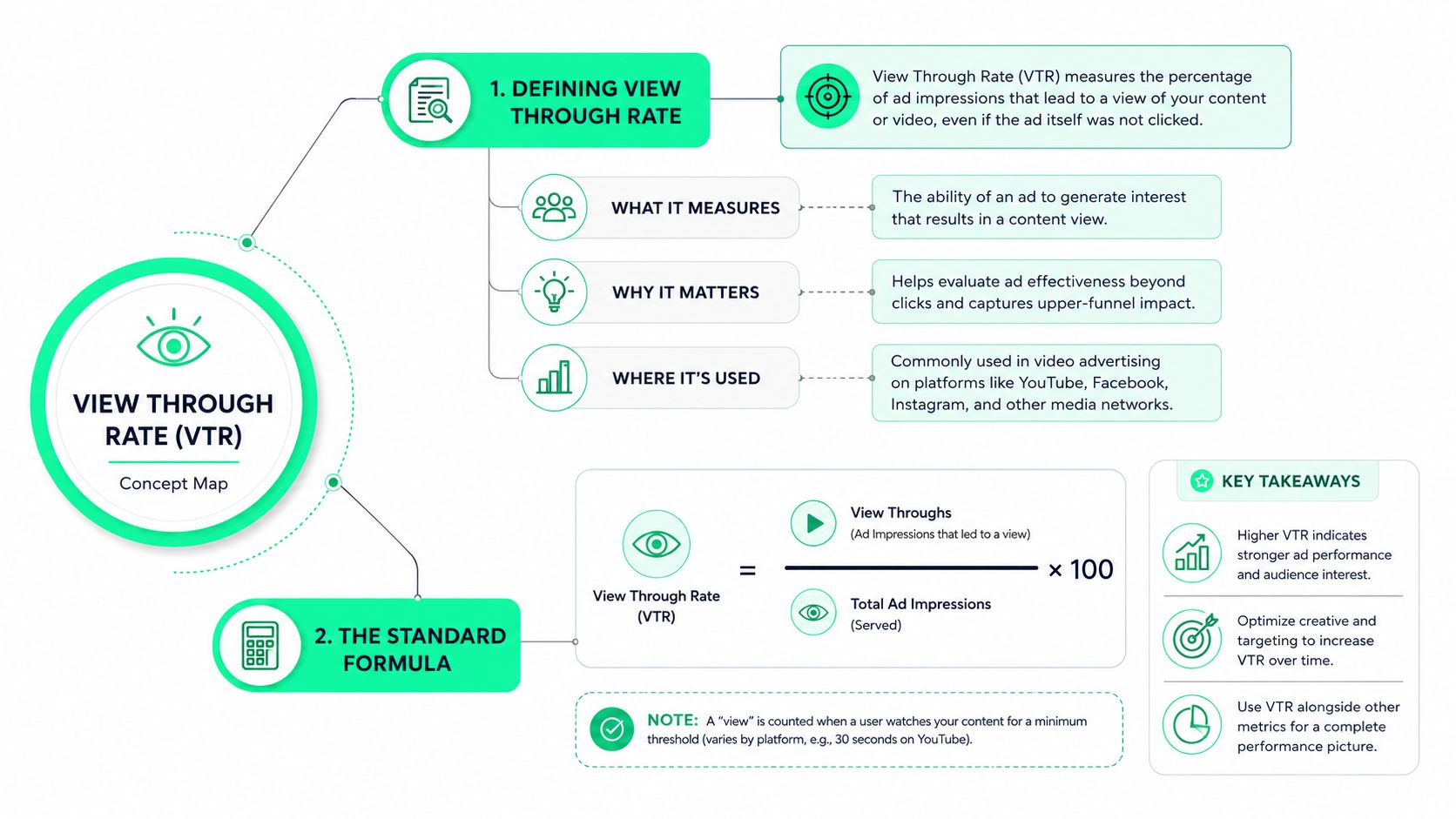
**View through rate is commonly calculated as completed views divided by impressions, multiplied by 100.** The standard formula is:
**VTR = (completed views ÷ impressions) × 100**
The formula looks simple, but the inputs need definition. Impressions represent delivered opportunities for the video to appear. Completed views represent the views that satisfy the platform's completion rule. A creator can't interpret the resulting rate without knowing what the platform considers complete.
### VTR and view-through conversions are different
VTR measures **attention generated from impressions**. View-through conversions measure an action that happens after someone sees an ad without clicking, within the platform's selected attribution window. One metric describes who stayed with the video. The other describes who acted later.
A useful analogy is simple: **VTR tells a marketer who stayed for the show, while view-through conversions tell the marketer who bought a ticket afterward**. A completed view can be valuable evidence of attention, but it isn't proof of purchase intent.
The distinction prevents a common reporting mistake. A creator may see strong completion and assume the audience is ready to subscribe, visit a product page, or buy. That conclusion goes beyond what VTR can establish. The analyst needs a downstream event that corresponds to the objective.
### Why dashboards don't line up
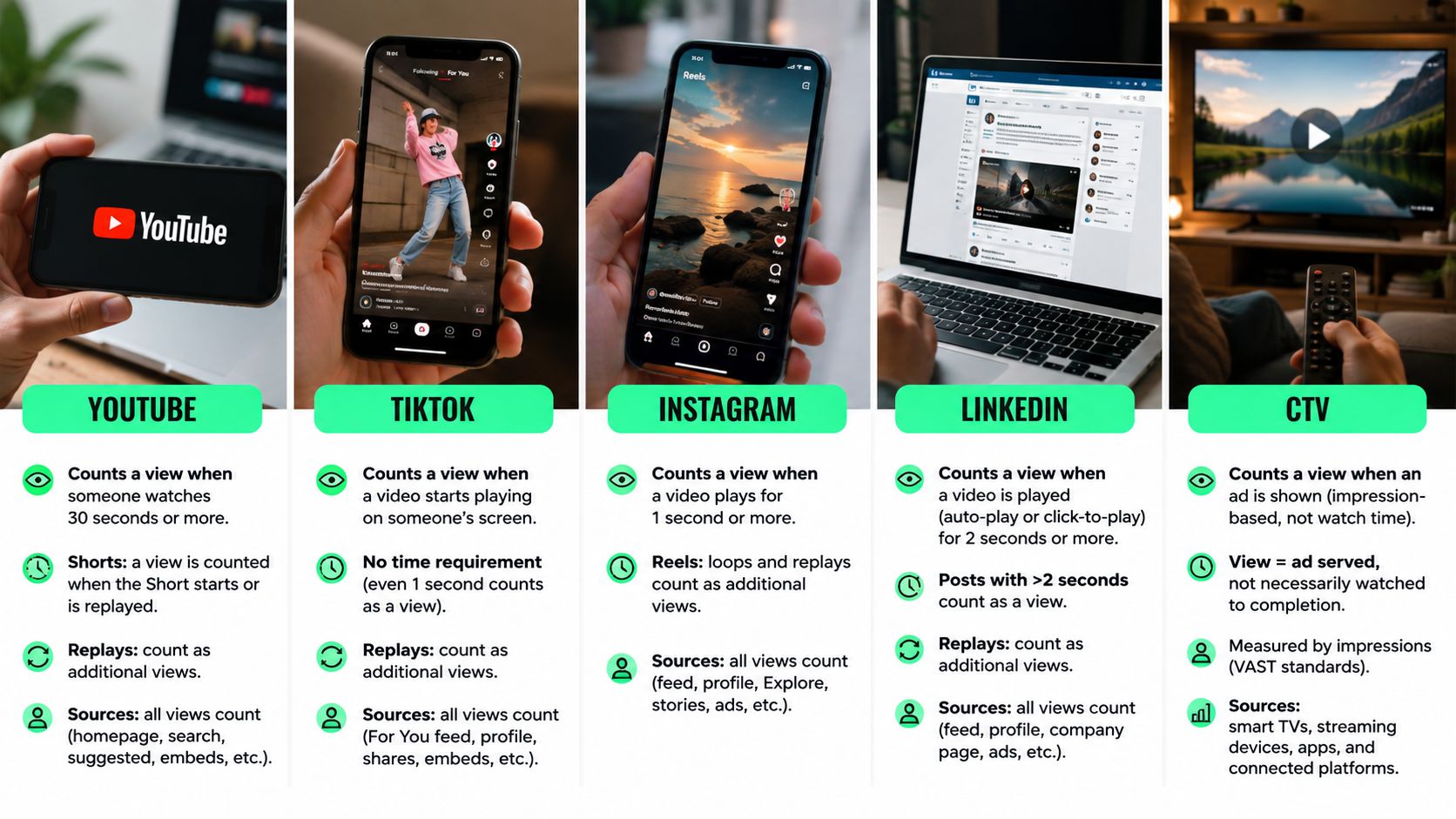
Platforms can define a qualifying view using different thresholds, including **2 seconds, 3 seconds, 25%, 75%, or full completion**, depending on placement and objective, as described in the [view-through rate definition](https://www.incrmntal.com/glossary/view-through-rate-vtr). A 30-second YouTube TrueView view therefore measures a different depth of attention from a 3-second social-feed view.
Creators should record four fields beside every benchmark:
- **View threshold:** The time, percentage, or completion condition required.
- **Denominator:** Impressions, starts, or another platform-defined opportunity.
- **Placement:** Feed, Shorts, in-stream, social story, LinkedIn feed, or CTV.
- **Objective:** Awareness, completion, traffic, lead generation, or conversion.
Without those fields, a percentage creates false precision. The correct question isn't whether one platform's VTR is higher in isolation. It's whether the same definition, audience, placement, and creative length support a fair comparison.
## How YouTube, TikTok, Instagram, LinkedIn, and CTV Count Views Differently
A creator reposting one clip across several surfaces isn't running one measurement experiment. The same file enters different playback environments, uses different qualifying-view rules, and may expose viewers to different device behavior.
YouTube TrueView can count a qualifying view according to its own threshold and placement rules. A 30-second TrueView view and a short social-feed view don't represent identical attention depth. Google Ads renamed its “Views” metric to **“TrueView views” in October 2025**, a change that highlights how platform terminology can shift rather than settle into one universal standard, as described in the cross-platform VTR benchmark discussion.
TikTok and Instagram Reels commonly place video in an autoplay feed, where the first moments determine whether a viewer continues. The qualifying event may use a short time threshold or another platform-specific definition. LinkedIn also delivers video in a feed, but its professional context, playback behavior, and reporting environment make its view number a separate observation, not a direct substitute for TikTok or Reels data.
CTV behaves differently again. The viewer usually encounters a scheduled or inserted television-style placement rather than a swipe-driven feed. Completion can therefore reflect a different mix of device control, viewing context, and creative length. A CTV completion figure should stay in its own comparison group instead of serving as a target for a vertical social clip.
### A normalization checklist
Before a creator quotes a benchmark or judges a repost, the reporting sheet should answer:
1. **What qualifies as a view?** A short time threshold, a percentage watched, or full completion?
2. **What is the denominator?** Impressions, starts, or another platform-defined base?
3. **What was the placement and device?** Feed, in-stream, Shorts, LinkedIn, or CTV?
4. **How long was the clip?** Runtime changes the probability of completion.
5. **Was the objective comparable?** Awareness and conversion campaigns can optimize for different events.
The practical consequence is clear in [the comparison of Reels, TikTok, and Shorts](https://blitzreels.com/blog/reels-tiktok-or-shorts-which-platform-is-best-for-creators-in-2026). A creator should optimize each upload for its native environment, then compare trends within that environment. Cross-platform reporting becomes useful only after the definitions are normalized.
## Benchmarks for Short-Form Platforms in 2026
A single “good VTR” target hides the main variable: runtime. Completion usually declines as a clip gets longer, yet the slope differs by platform and format. The table below is therefore a set of duration-specific reference points, not a universal scorecard.
| Format | Length | Typical VTR or Completion | What Strong Looks Like |
|---|---:|---:|---|
| TikTok | 10 seconds or less | 81.2% completion | The source reports 81.2% for this band |
| TikTok | 11 to 15 seconds | 76.4% completion | Compare within the same duration band |
| TikTok | 16 to 30 seconds | 52.6% completion | A materially lower target than sub-15-second clips |
| TikTok | 31 to 60 seconds | 41.8% completion | Judge against similarly edited clips |
| TikTok | 61 to 90 seconds | 31.4% completion | Stronger pacing becomes increasingly important |
| TikTok | Longer than 90 seconds | 22.7% completion | A long runtime needs a clear reason to continue |
| YouTube Shorts | Under 15 seconds | 40% to 55% completion | Above 55% is strong, above 65% is exceptional |
| YouTube Shorts | 15 to 30 seconds | 30% to 40% completion | Compare with clips in this range |
| YouTube Shorts | 30 to 45 seconds | 25% to 35% completion | A tighter edit can improve the opportunity |
| YouTube Shorts | 45 to 60 seconds | 20% to 30% completion | The payoff must justify the duration |
The TikTok figures come from the [2026 completion-rate roundup](https://insights.ttsvibes.com/tiktok-video-completion-rate-statistics/). The YouTube Shorts ranges come from [2026 Shorts completion benchmarks](https://retensis.com/blog/youtube-shorts-completion-rate-benchmarks-2026), which also describes completion above 65% for sub-15-second Shorts as a possible replay signal. Treat both sources as directional benchmarks, since platform definitions, placements, audiences, and reporting windows can differ.
### Runtime changes the editing problem
Short clips give viewers fewer opportunities to leave before the payoff. Longer clips require a clearer sequence of information, tension, humor, or visual change. A 45-second tutorial should not be cut to 12 seconds if the explanation needs room, but every pause that does not advance the idea should go.
A creator reviewing [video analytics](https://blitzreels.com/glossary/video-analytics) should group clips by platform, placement, and duration before judging completion. A 15-second cut and a 45-second cut answer different editing questions. Comparing them directly can label the longer video weak even when it holds attention appropriately for its format.
The benchmark also points to specific edits. Put the claim or outcome in the opening, remove repeated setup, and use captions or title cards to make the payoff legible without sound. For a longer clip, add a meaningful beat rather than filler. For a shorter clip, preserve only the context needed to understand the claim.
Use VTR to identify whether the opening earns a counted view, then compare hold rate at the explanation and payoff. If viewers complete but show little conversion intent, revise the promise or call to action rather than shortening the video again. Runtime sets the baseline. The edit must earn every additional second.
## When a High VTR Is Misleading and What to Measure Instead
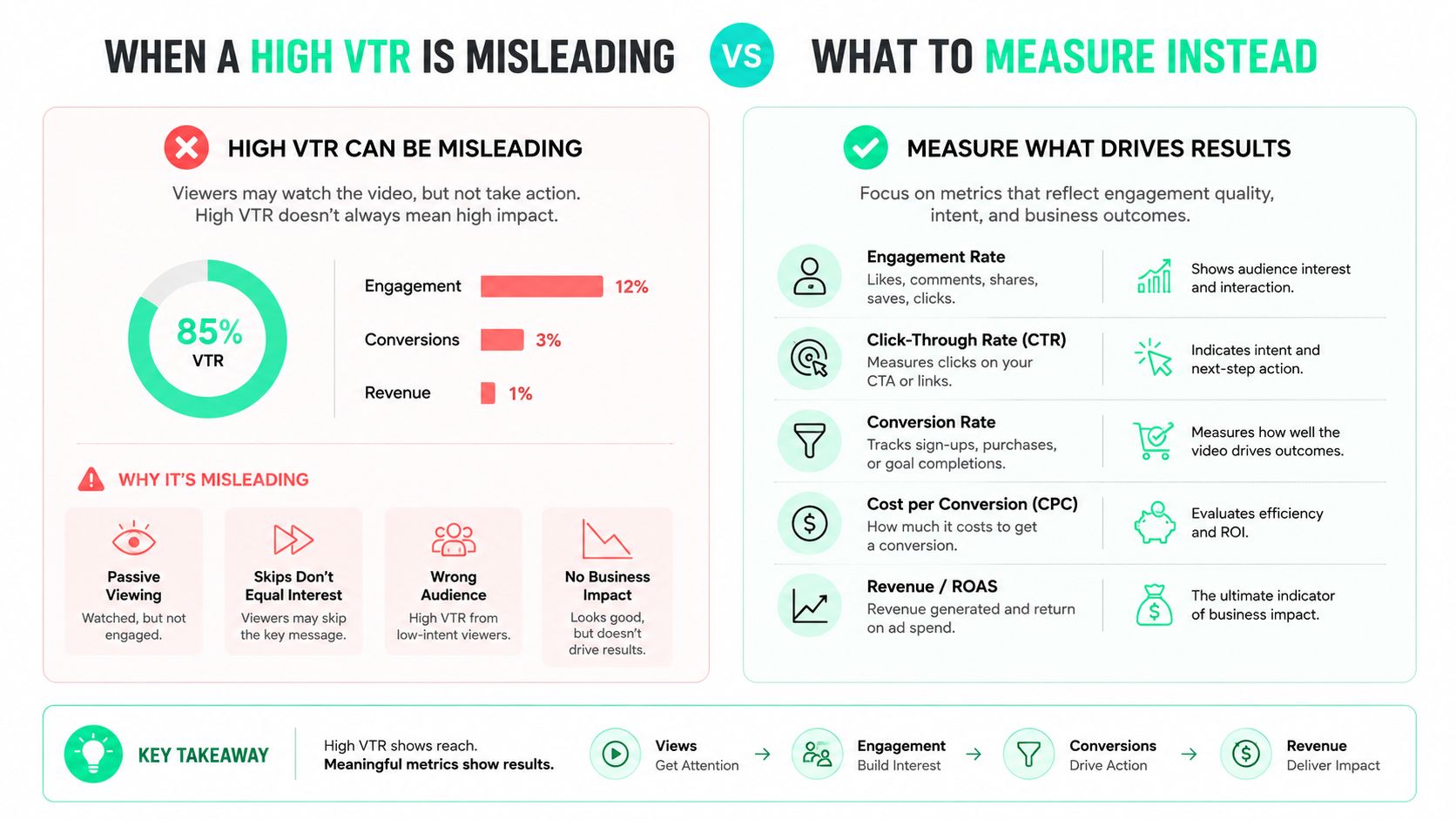
A high VTR can coexist with weak business performance. A passive video may attract completion because it is short or visually easy to watch, while the audience remains too broad, the message stays vague, or the viewer has no reason to take the next step.
Completion also doesn't reveal whether attention stayed evenly distributed. A viewer can satisfy a platform's counted-view rule and leave before the central explanation. That's why creators need a small measurement triangle rather than a single north-star metric.
### The three signals
- **VTR measures counted attention:** It shows how many impressions became qualifying views under the platform's rule.
- **Hold rate measures continued attention:** It shows whether viewers stayed through the important sections of the clip rather than only reaching the initial threshold.
- **View-through conversions measure later action:** They connect exposure to an action inside a defined attribution window, but they still need careful interpretation.
These metrics answer different questions. VTR asks whether the opening earned a counted view. Hold rate asks whether the structure sustained interest. View-through conversions ask whether exposure preceded a business action without a click.
> A completed view is evidence of attention, not evidence of intent.
The right optimization priority depends on the objective. Awareness work should emphasize whether the message holds attention through the brand or idea. Mid-funnel work can use VTR as a stronger diagnostic for creative relevance, while conversion work should give greater weight to view-through conversions and the quality of the resulting action.
Creators should also watch for a misleading winner. A broad, curiosity-heavy clip may produce strong completion but attract viewers who never fit the offer. A narrower clip may deliver less impressive completion while generating more qualified visits or leads. The second video can be more valuable even if its VTR looks less exciting.
The analyst's job is to connect the metrics in sequence. If VTR is weak, repair the opening. If VTR is healthy but hold rate drops at the explanation, fix pacing or clarity. If both look sound but conversions remain weak, question audience fit, promise, offer, and attribution rather than adding more visual effects.
## Editing Moves That Lift Short-Form VTR
VTR responds to decisions made before publishing. The most useful edits reduce uncertainty early, keep visual information changing, and make the spoken idea readable even when the viewer isn't listening.
### Start with a specific promise
The first two seconds should identify the tension, result, mistake, or question. A hook such as “This edit loses viewers before the lesson starts” creates a clearer reason to continue than a long greeting. Creators looking for a concise explanation can review [the three second hook rule](https://shipteaser.com/blog/three-second-hook), then adapt the principle to the platform's own view definition.
A curiosity gap works when the video withholds a useful answer without withholding the subject. The opening title card should match the spoken promise, not introduce a second topic. That alignment prevents viewers from spending early attention trying to understand what the clip is about.
### Cut for momentum
Cut pauses, repeated setup, and verbal detours. Cutting on a beat can make transitions feel intentional, while a title card or B-roll insert can reset attention between spoken lines. The edit shouldn't add motion for its own sake. Each visual change should clarify the argument, reveal evidence, or create a fresh reason to keep watching.
Captions should follow the spoken phrase closely, with emphasis reserved for the words carrying the meaning. Readable captions can preserve context when sound is off and reinforce the audio when sound is on. More guidance on this relationship appears in [how captions drive engagement on TikTok and Instagram](https://blitzreels.com/blog/how-captions-drive-engagement-on-tiktok-and-instagram).
### Fit the frame to the feed
A widescreen source can lose impact when placed in a vertical feed. Auto-reframing keeps a face or key object in view, while resizing protects title cards and captions from edge cropping. Creators repurposing interviews, webinars, screen recordings, or product demos should create the vertical composition before export, not treat it as an afterthought.
One practical workflow uses BlitzReels to upload a source file, generate captions, identify cuts, select an opening hook, reframe the subject, add title cards or B-roll, and export vertical versions for TikTok, Reels, and Shorts. The platform also supports templates and fast editing, which helps teams turn one source into channel-specific cuts without rebuilding every sequence manually.
The strongest workflow ends with subtraction. Once the value stops compounding, the clip should end, even if the original recording continues. A clean exit protects completion and leaves the viewer with a complete idea rather than a slow fade into unrelated material.
## A Weekly Measurement Routine for Testing and Improving VTR
A weekly routine turns VTR from a passive report into an editing system. The process should isolate one creative decision at a time, because changing the hook, caption style, runtime, and cut cadence together makes the result difficult to interpret.
1. **Choose one variable:** Select the hook, opening shot, caption treatment, or cut cadence.
2. **Create two variants:** Keep the topic, offer, footage, and destination consistent while changing only the selected variable.
3. **Use comparable windows:** Publish to similar audience conditions instead of comparing a quiet release with an unusually broad push.
4. **Set a fixed review point:** Hold the test until each version has enough comparable exposure to support a useful decision.
5. **Read native analytics:** Check views, watch time, completion, and retention behavior before likes or comments.
6. **Record the lesson:** Promote the stronger version, archive the weaker one, and write one sentence explaining what changed.
This is a practical [A/B testing framework](https://blitzreels.com/glossary/a-b-testing), not a search for a permanently winning format. If one post receives a wider organic push, raw VTR needs context. The creator should compare like-for-like placements, audience sources, runtime groups, and retention patterns before declaring a winner.
A result with too little exposure shouldn't drive a major creative change. VTR is a leading indicator of distribution and attention, not a guarantee of revenue. The useful outcome is a repeatable lesson, such as a direct opening outperforming a greeting, or tighter captions preserving attention through a dense explanation.
---
BlitzReels helps creators turn source videos into short-form edits with clipping, captions, hooks, reframing, resizing, title cards, templates, and fast exports for social platforms. Creators and small teams can use those tools to test more opening and pacing variants, then visit [BlitzReels](https://blitzreels.com) to build a faster measurement loop.