---
title: "What Is Video Marketing in 2026? Your Guide to Growth"
canonical: "https://blitzreels.com/blog/what-is-video-marketing"
---
# What Is Video Marketing in 2026? Your Guide to Growth
URL: https://blitzreels.com/blog/what-is-video-marketing
Markdown URL: https://blitzreels.com/blog/what-is-video-marketing.md
Published: 2026-06-05
Author: BlitzReels
What is video marketing in 2026? Learn to use short-form video for TikTok & Reels to grow your brand. Get a practical guide to strategy, KPIs, & tools.
Tags: what is video marketing, video marketing strategy, short-form video, content marketing, blitzreels

Video marketing is the strategic use of video content to attract, engage, and convert an audience, and by 2025 **89% of businesses** were using it while **95%** said it was important to their strategy. In practice, that now means building a repeatable system for short-form clips, platform-specific edits, and measurable performance, not just publishing the occasional polished brand video.
The definition matters because the format has changed. Video isn't centered on desktop viewing or long production cycles anymore. More than **75% of video views** happen on mobile, and **78% of people** watch online videos weekly according to [Insivia's 2025 video marketing statistics roundup](https://www.insivia.com/video-marketing-statistics-you-must-know-in-2025/). That pushes brands toward concise storytelling, faster editing, captions, vertical framing, and constant iteration across TikTok, Instagram Reels, YouTube Shorts, LinkedIn, and similar feeds.
A founder asking what video marketing is in 2026 usually isn't asking for a dictionary definition. The core question is what a business needs to do now to compete for attention. The answer is simpler than many guides make it sound. Record useful ideas, package them for the right stage of the funnel, publish in the formats people already consume, and improve based on watch behavior.
## Table of Contents
- [What Is Video Marketing in 2026](#what-is-video-marketing-in-2026)
- [The practical definition](#the-practical-definition)
- [Why Video Marketing Is Essential for Growth](#why-video-marketing-is-essential-for-growth)
- [Why businesses keep leaning into it](#why-businesses-keep-leaning-into-it)
- [Why short-form changed the pace](#why-short-form-changed-the-pace)
- [Key Video Formats and Their Strategic Roles](#key-video-formats-and-their-strategic-roles)
- [Short-form for discovery](#short-form-for-discovery)
- [Longer formats for consideration and conversion](#longer-formats-for-consideration-and-conversion)
- [Building Your Video Marketing Strategy](#building-your-video-marketing-strategy)
- [Start with a narrow objective](#start-with-a-narrow-objective)
- [Build a workflow you can maintain](#build-a-workflow-you-can-maintain)
- [Measuring Success with the Right KPIs](#measuring-success-with-the-right-kpis)
- [Views are only the surface](#views-are-only-the-surface)
- [What each KPI actually tells you](#what-each-kpi-actually-tells-you)
- [The Modern Workflow with AI and Automation Tools](#the-modern-workflow-with-ai-and-automation-tools)
- [Where teams lose time](#where-teams-lose-time)
- [What an efficient short-form workflow looks like](#what-an-efficient-short-form-workflow-looks-like)
- [Video Marketing Frequently Asked Questions](#video-marketing-frequently-asked-questions)
- [Do you need expensive gear](#do-you-need-expensive-gear)
- [How much should a business spend](#how-much-should-a-business-spend)
- [How long should videos be](#how-long-should-videos-be)
- [What should a business publish first](#what-should-a-business-publish-first)
## What Is Video Marketing in 2026
According to [DataReportal's global digital overview](https://datareportal.com/reports/digital-2025-global-overview-report), mobile phones account for the majority of web traffic worldwide. That matters because video marketing in 2026 is built for the way people discover content now: on phones, inside social feeds, and in short bursts of attention.
Video marketing is the use of video to create demand, explain value, build trust, and drive a next step. In practice, that includes short-form social posts, product demos, customer proof, educational clips, founder videos, webinar cutdowns, and ad creative. The difference in 2026 is that social-first distribution shapes the format from the start. Teams are no longer planning one polished asset and resizing it later. They are building for vertical viewing, silent autoplay, fast hooks, and repeatable publishing.
Short-form sits at the center of that shift.
For many businesses, "doing video marketing" now means producing a steady stream of useful, platform-native videos that can win attention in the first few seconds and still push the viewer toward a business outcome. That outcome might be a follow, a site visit, an email signup, a demo request, or a direct purchase. The format changes by channel, but the job stays the same.
### The practical definition
A useful definition has three parts:
- **Get attention:** Open with a clear hook, problem, claim, or visual change.
- **Deliver the message:** Teach, demonstrate, compare, entertain, or answer a real question.
- **Prompt an action:** Give the viewer one clear next step.
That framework sounds simple. The trade-off is execution. A brand video can look great and still fail if it does not match the platform, the audience's awareness level, or the action you want next. I usually treat video marketing as a system, not a single asset. If a team cannot explain who the video is for, where it will be distributed, and what result should follow, they are producing content without a marketing plan behind it.
The 2026 version also includes AI in the workflow. Teams now use AI to draft scripts, generate first cuts, turn long recordings into short clips, add captions, test variations, and repurpose the same idea across channels faster than a manual process allows. If you want a clearer breakdown of that shift, BlitzReels explains [what AI video means in modern content workflows](https://www.blitzreels.com/blog/what-is-ai-video).
This broader definition matters because video no longer sits in a silo. It supports search, social distribution, conversion, and retention together. Surnex makes that case well in its guide to [2026 video marketing success](https://surnex.io/blog/video-marketing-seo), especially for teams trying to connect content output with measurable growth.
## Why Video Marketing Is Essential for Growth
The business case is no longer speculative. By 2025, **89% of businesses** were using video marketing and **95%** said it was important to their strategy, while global spending on **short-form digital video advertising** was projected to reach **$111 billion in 2025**, up from **$99.43 billion** in 2024 according to [Wix's video marketing statistics roundup](https://www.wix.com/blog/video-marketing-statistics). That's not a niche trend. That's a mainstream channel with budget, process, and executive attention behind it.
Growth comes from what video does better than many static formats. It compresses explanation. It shows tone and personality. It demonstrates products in motion. It gives a founder, operator, or creator a faster path to trust than a wall of text usually can.
### Why businesses keep leaning into it
Some formats communicate value poorly in text alone. Product workflows, software interfaces, service delivery, before-and-after transformations, and educational breakdowns all become easier to understand when people can watch them happen.
Video also gives teams more ways to reuse one idea:
- **A webinar becomes clips** for Shorts, Reels, and LinkedIn.
- **A customer call becomes a testimonial** with captions and pull quotes.
- **A product walkthrough becomes a demo**, onboarding asset, and ad variation.
- **A founder insight becomes a social series** instead of a single post.
That reuse matters because growth rarely comes from one perfect asset. It comes from a steady stream of useful assets built from the same core message.
### Why short-form changed the pace
Short-form video accelerated the publishing rhythm. Teams don't have to wait for a quarterly campaign. They can react to customer objections, common questions, feature launches, and industry conversations in near real time.
> Video works best when the business treats it like ongoing communication, not a special event.
For creators and small teams, this shift also creates direct revenue opportunities around audience building, sponsorships, products, and services. BlitzReels has a relevant breakdown of [income streams for video creators](https://www.blitzreels.com/blog/stacking-your-income-7-revenue-streams-for-video-creators), which shows why video often becomes both a marketing engine and a business asset.
## Key Video Formats and Their Strategic Roles
A lot of failed video strategy comes from format mismatch. Teams use a product demo when the audience is still cold. Or they publish top-of-funnel entertainment and expect it to close a sale on its own. Strong video marketing assigns each format a job.
An effective system combines short-form and longer content across the funnel. Videos under 60 seconds are used for discovery and can generate **2.5x more engagement per impression**, while longer educational content remains important for deeper consideration and lead generation, according to [Digital Applied's 2026-focused video marketing data summary](https://www.digitalapplied.com/blog/video-marketing-statistics-2026-data-points).
### Short-form for discovery
Short-form earns attention at the top of the funnel. It works when the viewer doesn't know the brand yet and needs a fast reason to care.
Common examples include:
- **Hook-led social clips:** Strong opening line, tight pacing, subtitles, visual movement.
- **Opinion clips:** A founder or operator explains a contrarian point in plain language.
- **Educational snippets:** One problem, one answer, one clear takeaway.
- **Repurposed podcast or webinar moments:** One sharp insight trimmed into a vertical clip.
For this layer, editing choices matter a lot. Captions increase readability. Reframing keeps faces centered. Fast cuts remove dead air. Title cards tell people why they should stay.
Teams building this kind of content regularly often benefit from a focused workflow around [short-form video strategy and execution](https://www.blitzreels.com/blog/short-form-video), especially when they're clipping larger recordings into multiple platform-ready assets.
### Longer formats for consideration and conversion
Longer videos do different work. They answer objections, explain mechanics, and help a serious buyer evaluate the offer.
These formats usually include:
- **Explainer videos:** Good for clarifying what a product or service does.
- **Product demos:** Useful when buyers need to see the workflow.
- **Testimonials:** Strong when prospects want proof and credibility.
- **Webinars or tutorials:** Effective for education-heavy offers and more complex sales.
> A short clip starts the conversation. A stronger demo or explainer often closes the gap between curiosity and intent.
Here is a practical way to map formats to funnel stages:
| Video Format | Primary Goal | Best For Platforms | Example Use Case |
|---|---|---|---|
| Short-form social clip | Awareness | TikTok, Instagram Reels, YouTube Shorts, LinkedIn | Founder shares one strong industry insight |
| Educational clip | Engagement | Reels, Shorts, LinkedIn, YouTube | Answer a common customer question |
| Product demo | Consideration | Website, landing pages, YouTube, sales follow-up | Show how the product works in real use |
| Testimonial | Conversion | Website, ads, LinkedIn, sales enablement | Customer explains the problem and result |
| Webinar clip | Repurposing and nurture | LinkedIn, Shorts, email, YouTube | Turn one event into multiple follow-up assets |
Distribution details matter too. Even a strong clip can underperform if it isn't uploaded correctly or formatted for the channel. For teams publishing on X, MicroPoster has a useful guide to [video upload best practices](https://microposter.so/blog/how-to-upload-videos-on-twitter) that helps avoid preventable posting mistakes.
## Building Your Video Marketing Strategy
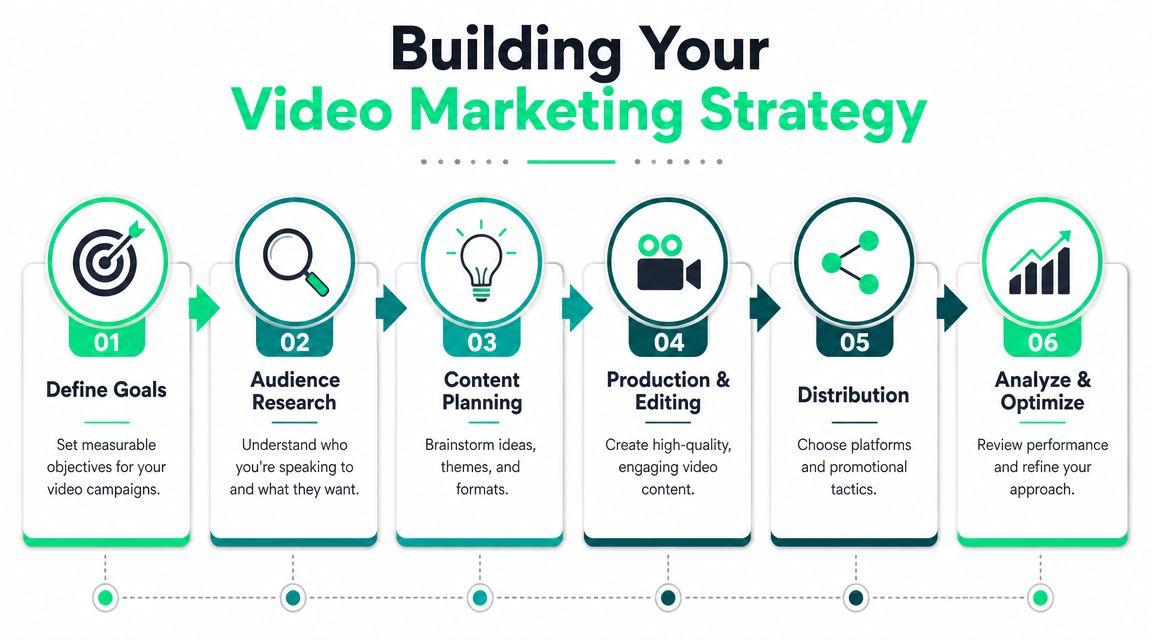
Random posting isn't a strategy. A useful plan tells the team what to create, why it matters, where it goes, and how often they can realistically ship it.
### Start with a narrow objective
Most businesses start too broad. "Grow with video" doesn't help anyone decide what to film next. A narrower objective does.
A workable starting framework looks like this:
1. **Pick one outcome first.** Choose awareness, lead generation, conversion support, or retention.
2. **Choose one audience segment.** New buyers, existing customers, job candidates, or followers from a specific platform.
3. **Match the format to the objective.** Short clips for discovery. Demos or explainers for deeper evaluation.
4. **Define the action.** Follow, subscribe, click, book, sign up, or reply.
When the goal is narrow, content gets clearer. Hooks get sharper. Editing choices become easier because the team knows what the video needs to accomplish.
### Build a workflow you can maintain
A strong strategy is sustainable before it's ambitious. It's often best to start with a manageable publishing rhythm and a small number of repeatable content types instead of trying to dominate every platform at once.
A practical setup often includes:
- **One core source of footage:** podcast, interview, Loom, webinar, customer call, or direct-to-camera recording.
- **A few repeatable formats:** tip clips, objection handling clips, demo snippets, testimonials.
- **Platform-specific finishing:** resize, crop, captions, title cards, and CTA placement.
- **A review loop:** check performance, keep what works, drop what doesn't.
> Consistency doesn't come from discipline alone. It comes from reducing the amount of custom work required for each video.
The strongest plans usually look boring on paper. They rely on recurring themes, reusable templates, and clear publishing decisions. That's what makes them workable month after month.
## Measuring Success with the Right KPIs
A lot of teams still judge video by raw views. That creates bad decisions fast. A video can collect views and still fail to hold attention, move interest, or generate action.
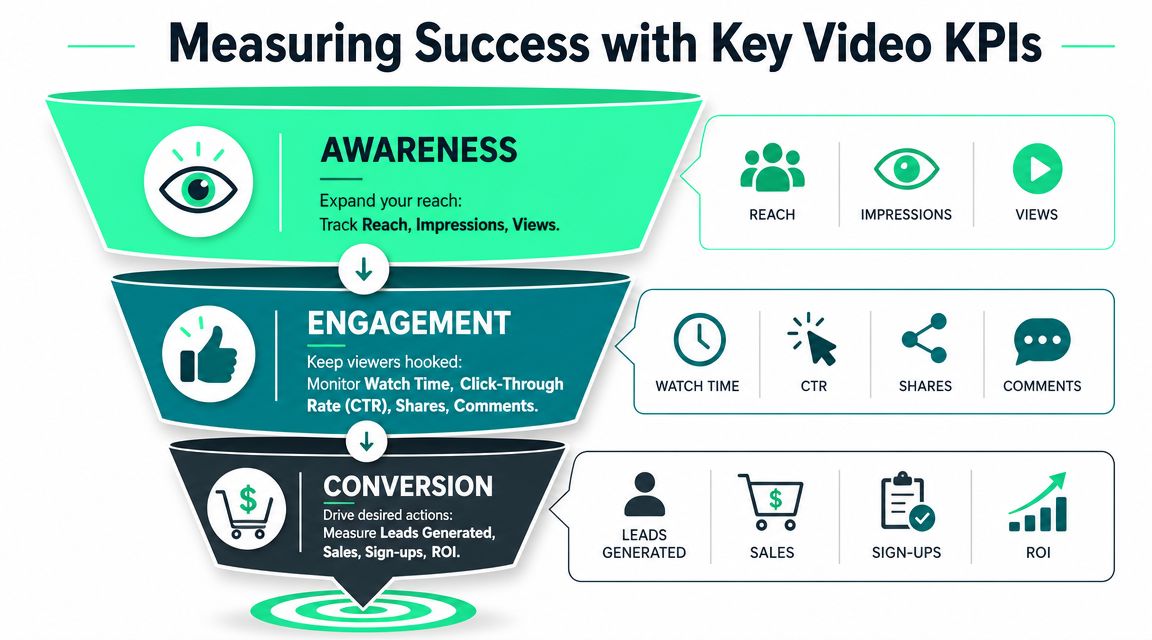
According to Switcher Studio's guide to [video marketing analytics](https://www.switcherstudio.com/blog/video-marketing-analytics), the core signals are **watch time**, **completion rate**, and **click-through rate**. Those are behavioral metrics. They show whether people stayed, finished, and took the next step.
### Views are only the surface
Views still have value. They can show distribution and initial reach. But they don't answer the harder questions.
Those harder questions are usually:
- **Did the opening hook work?**
- **Did people stay long enough to get the message?**
- **Did the CTA create action?**
If a short-form clip gets views but weak watch time, the hook may be misleading or the pacing may drag. If completion is low, the video may be too long or too slow. If completion is solid but CTR is weak, the message might land while the call to action doesn't.
### What each KPI actually tells you
Analytics gains utility for editing decisions instead of reporting theater.
- **Watch time:** Shows how much of the video people consumed. Strong watch time often points to a good opening and pacing.
- **Completion rate:** Shows how many people made it to the end. This helps evaluate length, structure, and clarity.
- **Click-through rate:** Shows whether viewers took action after watching. This reflects CTA strength, offer relevance, and placement.
A practical analytics habit is to review those metrics alongside the actual edit. That lets teams connect performance to specific creative choices such as the first line, subtitle style, visual pattern interrupts, or where the CTA appears.
For marketers who want a cleaner definition of these metrics, the BlitzReels glossary has a straightforward reference for [video analytics terms](https://www.blitzreels.com/glossary/video-analytics).
## The Modern Workflow with AI and Automation Tools
The biggest operational change in video marketing isn't just that more brands use video. It's that the workflow has compressed. AI-assisted production and repurposing are shifting teams toward faster, lower-friction systems for high-volume, platform-specific output, as described in Envato's guide to [modern video marketing workflows](https://elements.envato.com/learn/video-marketing-guide/).
### Where teams lose time
Most short-form bottlenecks aren't in recording. They're in post-production.
Common slow points include:
- **Finding usable moments** inside long recordings
- **Cutting dead air** without making the clip feel unnatural
- **Adding captions** that are readable on mobile
- **Reframing for vertical** so speakers stay centered
- **Resizing versions** for different platforms
- **Building consistency** with title cards, brand colors, and templates
Traditional editors can do all of this, but they often require manual work on every step. That's fine for a campaign film. It's a poor fit for a social-first publishing loop.
### What an efficient short-form workflow looks like
A modern workflow usually follows a simple pattern: record once, clip fast, package for the platform, then publish and learn.
That often means using tools that automate repetitive edits while still allowing manual control where it matters. A practical setup might include transcription, AI clip detection, subtitle styling, auto reframing, and preset templates.
BlitzReels is one example of that category. It takes uploaded video, generates transcripts, identifies candidate clips, adds captions, helps with reframing and resizing, and supports hooks, title cards, templates, and repurposing for vertical platforms. For teams exploring that model, BlitzReels also outlines an [AI-first editing workflow](https://www.blitzreels.com/blog/let-ai-handle-the-edits-your-new-video-workflow) in more detail.
A wider automation stack can also help around publishing, approvals, and campaign coordination. Teams comparing that broader category may find Mifu's [marketing automation software guide](https://mifu.io/blog/marketing-automation-software/) useful when deciding what should be automated outside the editing room.
This kind of workflow is easier to understand when seen in motion:
> Fast editing matters because short-form volume usually wins through iteration. Teams learn more by publishing, measuring, and refining than by polishing one clip for too long.
## Video Marketing Frequently Asked Questions
### Do you need expensive gear
No. A clear message, decent lighting, understandable audio, and clean editing matter more than expensive camera bodies for most short-form content. Many useful business videos start with a phone, a quiet room, and a simple script.
Captions also do a lot of heavy lifting. They improve readability on mobile and help when people watch with sound off. Good framing and clean subtitle styling usually matter more than cinematic production.
### How much should a business spend
That depends on the workflow, content volume, and whether the team records from scratch or repurposes existing footage. A founder posting direct-to-camera clips can keep costs relatively lean. A larger brand producing testimonials, demos, paid ads, and multi-platform variants will need a broader budget.
The useful question isn't "How cheap can video be?" It's "What production model can this team sustain?" A simple, repeatable system usually beats an expensive process that stalls after a few weeks.

### How long should videos be
The right length depends on the job of the video. Discovery clips should usually get to the point fast. Educational or product content can run longer if the information stays useful and the pacing stays tight.
A better rule than chasing one ideal length is this:
- **Use short-form for awareness and engagement**
- **Use deeper videos for explanation and evaluation**
- **Cut aggressively when a section doesn't earn attention**
- **Open with the strongest line, not the setup**
### What should a business publish first
Start with videos that answer common questions, handle objections, and explain the value of the offer. Those topics are easier to produce than abstract brand storytelling and often create faster feedback.
A strong starter mix usually includes one founder insight series, one educational series, and one product or service demonstration format. That gives the team variety without creating chaos.
---
BlitzReels helps teams turn raw footage, webinars, podcasts, tutorials, and direct-to-camera recordings into short-form videos with captions, clipping, reframing, resizing, title cards, and templates for platforms like TikTok, Reels, Shorts, and LinkedIn. For businesses that want a faster record-to-publish workflow without handling every edit manually, [BlitzReels](https://blitzreels.com) is a practical place to start.